Quarterly Financial Report for the Quarter Ended September 30, 2024
© His Majesty the King in Right of Canada, represented by the Military Police Complaints Commission of Canada, 2024
Catalogue No. DPE-1E-PDF | ISSN 2817‑223X
Table of contents
- Introduction
- Highlights of fiscal quarter and fiscal year to date results
- Risks and Uncertainties
- Significant changes in relation to operations, personnel, and programs
- Approval by Senior Officials
- Appendix A - Statement of Authorities (unaudited)
- Appendix B - Departmental Budgetary Expenditures by Standard Object (unaudited)
Statement outlining results, risks and significant changes in operations, personnel and program.
1. Introduction
This quarterly report has been prepared by management as required by section 65.1 of the Financial Administration Act and in the form and manner prescribed by the Treasury Board. This quarterly report should be read in conjunction with the Main Estimates. This report has not been subject to an external audit or review.
The Military Police Complaints Commission of Canada (the Commission) is an administrative tribunal and oversight agency created by Parliament to provide independent, civilian oversight of the Canadian Forces Military Police. The Commission reviews and investigates complaints concerning military police conduct and investigates allegations of interference in military police investigations. It reports its findings and makes recommendations directly to the Military Police and National Defence leadership. Further details on the Commission’s mandate and responsibilities may be found in the 2024-2025 Departmental Plan.
1.1 Basis of presentation
This quarterly report has been prepared by management using an expenditure basis of accounting. The accompanying Statement of Authorities includes the Commission’s spending authorities granted by Parliament and those used by the department, consistent with the Main Estimates and Supplementary Estimates (as applicable) for the fiscal year 2024-2025. This quarterly report has been prepared using a special purpose financial reporting framework designed to meet financial information needs with respect to the use of spending authorities.
The authority of Parliament is required before moneys can be spent by the Government. Approvals are given in the form of annually approved limits through appropriation acts or through legislation in the form of statutory spending authority for specific purposes.
When Parliament is dissolved for the purposes of a general election, section 30 of the Financial Administration Act authorizes the Governor General, under certain conditions, to issue a special warrant authorizing the Government to withdraw funds from the Consolidated Revenue Fund. A special warrant is deemed to be an appropriation for the fiscal year in which it is issued.
The Commission uses the full accrual method of accounting to prepare and present its annual departmental financial statements that are part of the departmental results reporting process. However, the spending authorities voted by Parliament remain on an expenditure basis.
2. Highlights of fiscal quarter and fiscal year to date results
Statement of Authorities
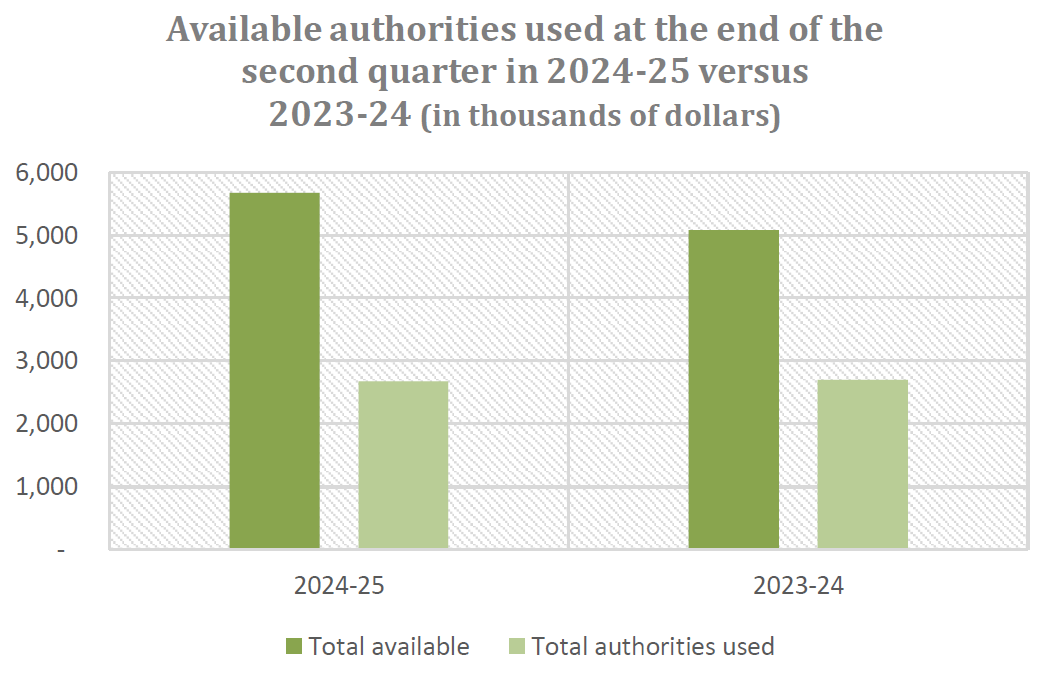
The total authorities available for use this fiscal year is $595,000 more than last fiscal year. This increase is mainly due to a $250,000 permanent and a $250,000 temporary transfer from the Department of National Defence (DND) received in fiscal year 2024-2025.
The Statement of Authorities also reveals that, as of September 30, 2024, 47% of the authorities available for use have been utilized, which is a decrease from the 53% utilization rate during the same period in the preceding fiscal year.
Statement of Departmental Budgetary Expenditures by Standard Object
During the second quarter of 2024-2025, expenses increased by $70,000 compared to the same period of the previous year. This variance is mostly explained by an increase of $181,000 in Personal expenses because of the retroactive pay for Law Practitioner (LP) and Law Management Occupational (LC) groups, partly offset by a decrease of $57,000 in Professional Services as a result of less expenditures related to investigative services and a decrease of $33,000 in rentals attributable to the period in which lease payments were settled.
The following graph shows the total available authorities and total authorities used in 2024-25 compared to 2023-24.
Alternate format
| Spending | 2024-25 | 2023-24 |
|---|---|---|
| Total Available | $5,673 | $5,078 |
| Total authorities used | $2,670 | $2,697 |
3. Risks and Uncertainties
The Commission operates on a complaint-based system, making it difficult to predict the number and complexity of complaints it will handle each year. Within the last few years, the Commission has experienced an unforeseeable increase in work related to the volume and complexity of complaints as well as an increase in its fixed operational costs. The Commission received a budget transfer from the Department of National Defence. This funding enabled us to add resources to an overburdened system to maintain the efficiency and speed of the complaints procedure. However, risks remain, and the Commission will strive to ensure that sufficient funds are available in the future to ensure that we can fulfil our mandate effectively within the allocated budget.
In addition to this risk, the Commission saw an increase in conduct complaint files related to sexual misconduct in the last few years, as well as an increase in the general workload of conduct complaints files, interference files, and Public Interest Investigations. Complex sexual misconduct files and public interest files are time consuming and require more resources. In addition to external investigator expenses, many other costs are incurred, such as legal services, court transcripts, investigator travel, interview transcriptions, and translation of key documents to comply with the Official Languages Act. The costs of these operational services received by external providers increase year after year. We have managed to reduce some of these increases by enhancing our investigation processes. This includes doing more investigative work internally whenever possible. In a micro-organization, Commission employees often hold unique positions with multiple responsibilities. Unlike in larger organizations, they do not have a direct feeder group for their roles. It is important to retain skilled employees and reduce hiring delays when vacancies arise. This is a constant challenge for a micro-organization. To mitigate this risk, the Commission will continue to be proactive in hiring and offering flexible work arrangements to employees, encourage innovation and provide development opportunities for staff.
4. Significant changes in relation to operations, personnel, and programs
In 2023, the Commission had to apply to the Federal Court to compel the Canadian Forces Provost Marshal to fully disclose information in three cases, ensuring fair and thorough investigations. These applications are still ongoing. The issues that led to this litigation have persisted and worsened this fiscal year, significantly increasing costs and delays in the complaints process and undermining the military police’s independent civilian oversight mechanism.
5. Approval by Senior Officials
This section is to provide the approval of Senior Officials, as required by the Policy on Financial Management.
Approved by:
________________________
Me Tammy Tremblay, MSM, CD, LL.M
Chairperson
________________________
Jean-François Poirier, CPA, M.A.P
Chief Financial Officer
Ottawa, Canada
November 7, 2024
Appendix A - Statement of Authorities (unaudited)
| Authority Vote/Statutory |
Total available for use for the year ended March 31, 2025Footnote 1 | Used during the quarter ended September 30, 2024 | Year to date used at quarter-end |
|---|---|---|---|
| Vote 1 - Net operating expenditures | 5,188 | 1,442 | 2,428 |
| Budgetary statutory authorities - Contributions to employee benefit plans | 485 | 121 | 242 |
| Total Authorities | 5,673 | 1,563 | 2,670 |
| Authority Vote/Statutory |
Total available for use for the year ended March 31, 2024Footnote 1 | Used during the quarter ended September 30, 2023 | Year to date used at quarter-end |
|---|---|---|---|
| Vote 1 - Net operating expenditures | 4,631 | 1,381 | 2,473 |
| Budgetary statutory authorities - Contributions to employee benefit plans | 447 | 112 | 224 |
| Total Authorities | 5,078 | 1,493 | 2,697 |
Appendix B - Departmental Budgetary Expenditures by Standard Object (unaudited)
| Expenditures | Planned expenditures for the year ending March 31, 2025 | Expended during the quarter ended September 30, 2024 | Year to date used at quarter-end |
|---|---|---|---|
| Personnel | 4,010 | 1,272 | 2,264 |
| Transportation and communications | 96 | 5 | 20 |
| Information | 50 | 2 | 14 |
| Professional and special services | 963 | 108 | 180 |
| Rentals | 474 | 153 | 168 |
| Repair and maintenance | 5 | 0 | 1 |
| Utilities, materials and supplies | 7 | 3 | 4 |
| Acquisition of land, buildings and works | 0 | 0 | 0 |
| Acquisition of machinery and equipment | 68 | 20 | 20 |
| Other subsidies and payments | 0 | 0 | -1 |
| Total net budgetary expenditures | 5,673 | 1,563 | 2,670 |
| Expenditures | Planned expenditures for the year ending March 31, 2024 | Expended during the quarter ended September 30, 2023 | Year to date used at quarter-end |
|---|---|---|---|
| Personnel | 3,389 | 1,091 | 2,146 |
| Transportation and communications | 82 | 28 | 52 |
| Information | 63 | 4 | 15 |
| Professional and special services | 920 | 165 | 253 |
| Rentals | 456 | 186 | 202 |
| Repair and maintenance | 13 | 2 | 2 |
| Utilities, materials and supplies | 15 | 1 | 1 |
| Acquisition of land, buildings and works | 20 | 0 | 0 |
| Acquisition of machinery and equipment | 120 | 16 | 26 |
| Other subsidies and payments | 0 | 0 | 0 |
| Total net budgetary expenditures | 5,078 | 1,493 | 2,697 |
- Date modified: