Quarterly Financial Report for the Quarter Ended June 30, 2025
©His Majesty the King in Right of Canada, represented by the Military Police Complaints Commission of Canada, 2025
ISSN 2817‑223X
Table of contents
- Introduction
- Highlights of fiscal quarter and fiscal year to date results
- Risks and Uncertainties
- Significant changes in relation to operations, personnel, and programs
- Approval by Senior Officials
- Appendix A - Statement of Authorities (unaudited)
- Appendix B - Departmental budgetary expenditures by Standard Object (unaudited)
Statement outlining results, risks and significant changes in operations, personnel and program.
1. Introduction
This quarterly report has been prepared by management as required by section 65.1 of the Financial Administration Act and in the form and manner prescribed by the Treasury Board. This quarterly report should be read in conjunction with the Main Estimates. This report has not been subject to an external audit or review.
The Military Police Complaints Commission of Canada (the Commission) is an administrative tribunal and oversight agency created by Parliament to provide independent, civilian oversight of the Canadian Forces Military Police. The Commission reviews and investigates complaints concerning military police conduct and investigates allegations of interference in military police investigations. It reports its findings and makes recommendations directly to the Military Police and National Defence leadership. Further details on the Commission’s mandate and responsibilities may be found in the 2025-2026 Departmental Plan.
1.1 Basis of Presentation
This quarterly report has been prepared by management using an expenditure basis of accounting. The accompanying Statement of Authorities includes the Commission’s spending authorities granted by Parliament and those used by the department, consistent with the Main Estimates and Supplementary Estimates (as applicable) for the fiscal year 2025-2026. This quarterly report has been prepared using a special purpose financial reporting framework designed to meet financial information needs with respect to the use of spending authorities.
The authority of Parliament is required before moneys can be spent by the Government. Approvals are given in the form of annually approved limits through appropriation acts or through legislation in the form of statutory spending authority for specific purposes.
When Parliament is dissolved for the purposes of a general election, section 30 of the Financial Administration Act authorizes the Governor General, under certain conditions, to issue a special warrant authorizing the Government to withdraw funds from the Consolidated Revenue Fund. A special warrant is deemed to be an appropriation for the fiscal year in which it is issued.
The Commission uses the full accrual method of accounting to prepare and present its annual departmental financial statements that are part of the departmental results reporting process. However, the spending authorities voted by Parliament remain on an expenditure basis.
2. Highlights of fiscal quarter and fiscal year to date results
Statement of Authorities
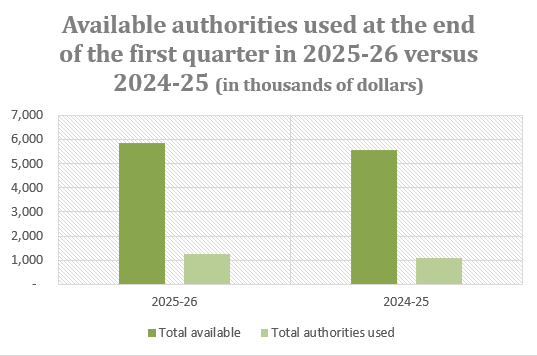
The total authorities available this year are $290,000 higher than last year. This is explained by the $206,000 increase in compensation adjustments, as well as an $84,000 increase in employee benefit plan contributions.
The statement of authorizations also reveals that, as of June 30, 2025, 21% of available authorities had been utilized, which is very similar to the utilization rate of 20% during the same period last year.
Statement of Departmental Budgetary Expenditures by Standard Object
During the first quarter of 2025-26, expenses increased by $150,000 compared to the same period of the previous year. This variance is mostly explained by an increase of $58,000 in Personnel expenses due to increases in salary expenses and an increase of $73,000 in Rentals as a result of a difference in the timing of rental invoices.
The following graph shows the total available authorities and total authorities used in 2025-26 compared to 2024-25.
Alternate format
| Available authorities | 2025-26 | 2024-25 |
|---|---|---|
| Total available | $5,877 | $5,587 |
| Total authorities used | $1,257 | $1,107 |
3. Risks and Uncertainties
Lost of trust in the military police and the oversight regime
One of the significant challenges the MPCC is facing is the erosion of its ability to exercise civilian oversight of the military police. Without legislative reform to strengthen the MPCC’s mandate, and ensure it has access to information needed to investigate complaints, there is a risk that the barriers it faces will continue to dilute the will of Parliament’s intent in establishing a civilian oversight regime for the military police. Many of the MPCC’s challenges to obtain access to information to carry out its mandate would have been alleviated with the implementation of Justice Fish’s recommendations in the Third Independent Review of the National Defence Act released in 2021. Further delays in reform risk damaging the reputations of both the MPCC and the military police, while undermining fairness and accountability. For this reason, the MPCC drafted a proposed Bill strengthening the civilian oversight of the military police and shared it with the Minister of National Defence and Stakeholders in December 2024.
Effective and timely complaint processes and investigations regarding military police conduct or interference in military police investigations are crucial for preserving public confidence and ensuring justice for all parties.
Human resources management
The small size of the MPCC means that employees often shoulder a broader spectrum of responsibilities compared to their counterparts in larger departments. These multi-faceted roles often demand a diverse skill set. However, attracting and retaining skilled employees can be challenging, due to the limited advancement opportunities, this calls for efficient hiring practices to promptly fill vacancies. Implementing sustainable human resource management strategies is paramount to maintaining stability, compliance, productivity, and overall effectiveness.
The MPCC is dedicated to fostering a strong, diverse, and knowledgeable workforce by advancing human resources planning, implementing proactive staffing processes, and focusing on talent management. We are committed to providing development opportunities, enhancing employee engagement, and offering flexible work arrangements. Additionally, we will continue to ensure a safe working environment that encourages productivity, stewardship and innovation.
4. Significant changes in relation to operations, personnel, and programs
Information Access and Operational Challenges
The MPCC has experienced significant challenges in acquiring all relevant information required from the Canadian Forces Provost Marshal (CFPM) to complete its reviews and investigations in an effective and timely manner. Persistent obstacles and restrictive interpretations of the National Defence Act exacerbate delays, increase costs, and jeopardize the MPCC’s ability to meet service standards. Without access to comprehensive and relevant information, the MPCC cannot carry out its core responsibilities of preparing timely reports as mandated by Parliament.
To address these challenges, the MPCC is actively pursuing all avenues to obtain the necessary documents, sometimes engaging in costly legal procedures before the Federal Court as part of its efforts. Open communication with the CFPM’s office is crucial to reducing delays and ensuring an effective complaints process.
5. Approval by Senior Officials
This section is to provide the approval of Senior Officials, as required by the Policy on Financial Management.
________________________
Me Tammy Tremblay, MSM, CD, LLM
Chairperson
________________________
Jean-François Poirier, CPA, M.P.A
Chief Financial Officer
Ottawa, Canada
July 11, 2025
Appendix A - Statement of Authorities (unaudited)
| Authority Vote/Statutory |
Total available for use for the year ended March 31, 2026Note 1 | Used during the quarter ended June 30, 2025 | Year to date used at quarter-end |
|---|---|---|---|
| Vote 1 - Net operating expenditures | 5,308 | 1,115 | 1,115 |
| Budgetary statutory authorities - Contributions to employee benefit plans | 569 | 142 | 142 |
| Total Authorities | 5,877 | 1,257 | 1,257 |
| Authority Vote/Statutory |
Total available for use for the year ended March 31, 2025Note 1 | Used during the quarter ended June 30, 2024 | Year to date used at quarter-end |
|---|---|---|---|
| Vote 1 - Net operating expenditures | 5,102 | 986 | 986 |
| Budgetary statutory authorities - Contributions to employee benefit plans | 485 | 121 | 121 |
| Total Authorities | 5,587 | 1,107 | 1,107 |
Appendix B - Departmental Budgetary Expenditures by Standard Object (unaudited)
| Expenditures | Planned expenditures for the year ending March 31, 2026 | Expended during the quarter ended June 30, 2025 | Year to date used at quarter-end |
|---|---|---|---|
| Personnel | 4,290 | 1,050 | 1,050 |
| Transportation and communications | 90 | 25 | 25 |
| Information | 65 | 10 | 10 |
| Professional and special services | 860 | 69 | 69 |
| Rentals | 465 | 87 | 87 |
| Repair and maintenance | 11 | 0 | 0 |
| Utilities, materials and supplies | 10 | 2 | 2 |
| Acquisition of land, buildings and works | 0 | 0 | 0 |
| Acquisition of machinery and equipment | 86 | 12 | 12 |
| Other subsidies and payments | 0 | 2 | 2 |
| Total net budgetary expenditures | 5,877 | 1,257 | 1,257 |
| Expenditures | Planned expenditures for the year ending March 31, 2025 | Expended during the quarter ended June 30, 2024 | Year to date used at quarter-end |
|---|---|---|---|
| Personnel | 4,000 | 992 | 992 |
| Transportation and communications | 96 | 15 | 15 |
| Information | 50 | 12 | 12 |
| Professional and special services | 887 | 72 | 72 |
| Rentals | 474 | 14 | 14 |
| Repair and maintenance | 5 | 1 | 1 |
| Utilities, materials and supplies | 7 | 1 | 1 |
| Acquisition of land, buildings and works | 0 | 0 | 0 |
| Acquisition of machinery and equipment | 68 | 0 | 0 |
| Other subsidies and payments | 0 | 0 | 0 |
| Total net budgetary expenditures | 5,587 | 1,107 | 1,107 |
- Date modified: