2023‑24 Departmental Results Report
____________________________
The Honourable Bill Blair, P.C., C.O.M., M.P.
Minister of National Defence
© His Majesty the King in Right of Canada, represented by the Military Police Complaints Commission of Canada, 2024
Cat No. DP2‑7E‑PDF | ISSN 2560‑9157
Table of contents
From the Institutional Head

Me Tammy Tremblay,
Chairperson
I am pleased to present the 2023-24 Departmental Results Report for the Military Police Complaints Commission of Canada (the MPCC). This report provides detailed information about the organization’s achievements in providing civilian oversight of the military police.
Strong accountability mechanisms are critical to maintaining public trust in policing. As Chairperson of the MPCC, I am committed to enhancing military policing through accountability.
This year the MPCC issued 13 Final Reports outlining the results of its investigations into allegations of military police misconduct or allegations of interference in a military police investigation. The MPCC also dealt with 10 Public Interest Investigations. These investigations are inherently complex and resource intensive and deal with serious matters such as sexual assault, arson, and attempted murder. Additionally, we issued a record number of 17 extension of time decisions, many involving allegations of sexual misconduct.
This year the MPCC met or exceeded all its target results indicators on quality, transparency and timeliness. Regrettably, the only target we did not meet was the acceptance rate of our recommendations by the Canadian Forces Provost Marshal, which dropped significantly.
Challenges and Improvements
The complexity and volume of complaints remained high this year, while we continued to experience a delay in the appointment and re-appointment of our decision-makers. We also expended considerable time and resources to obtain necessary information for our investigations from the military police. Despite these challenges, the MPCC significantly improved its timeliness, increasing the percentage of Interim Reports issued within the target timeframe from 50% to 70%.
Once again this year, the MPCC is proud that no designated employment equity group is under-represented among its workforce. Among others, 32% of employees identified themselves as members of a visible minority and 16% as people with disabilities, an increase from the previous year.
Collaboration and Communication
While no formal meetings took place between the MPCC and the office of the Canadian Forces Provost Marshal, ongoing conversations continued at the working level. Although the acceptance of MPCC recommendations declined significantly to 30%, and litigation continues before the Federal Court to clarify the respective roles and mandates, the MPCC remains committed to improving communication and collaboration with the Canadian Forces Provost Marshal and other stakeholders.
In last year’s report I announced that the MPCC would implement a follow-up process to track the progress of accepted recommendations by the Canadian Forces Provost Marshal to enhance accountability and transparency. Unfortunately, the Canadian Forces Provost Marshal refused to provide updates to the MPCC on the implementation of its recommendations citing a lack of legislative obligation to do so. This decision is regrettable as it misses an opportunity to inform Canadians, especially those directly impacted by these recommendations, about their implementation.
Enhancing Review and Investigation Capacity
This year, we made significant strides in strengthening our review and investigation capacity. This included updating intake procedures, streamlining the investigative process, and ensuring the use of plain language in our decision writing. Our staff received additional training on trauma-informed approaches, and we leveraged technology to improve the timeliness and efficiency of our investigations.
Legislative Reform to Improve Civilian Oversight of the Military Police
Despite many Independent Reviews of the National Defence Act since 1998, there have been no significant enhancements to independent civilian oversight of the military police. Consequently, the MPCC now falls significantly behind other police oversight mechanisms in Canada, particularly the Civilian Review and Complaints Commission for the RCMP, after which it was originally modelled. As a robust mandate to review military police conduct is crucial to maintaining public trust in policing, the MPCC continued to advocate for legislative reform including by writing to the Minister of National Defence on proposals to enhance civilian oversight of the military police.
Gratitude and Appreciation
I would like to extend my gratitude to all the employees of the MPCC. Your dedication, hard work, and unwavering commitment have been instrumental in achieving our goals and navigating the challenges we faced this year.
Your efforts in responding to information requests promptly, conducting thorough investigations, and ensuring transparency, including through corporate reporting, have not gone unnoticed. Each of you has played a crucial role in upholding the integrity and effectiveness of our oversight mandate. I am proud to work alongside such a talented and dedicated team.
Finally, I wish to acknowledge the members of the public, complainants, and the military police members who have entrusted us with their concerns. Your voices are vital to our work, and we are dedicated to addressing your complaints with respect and the utmost diligence.
Sincerely,
Me Tammy Tremblay, MSM, CD, LL.M
Chairperson
Results – what we achieved
Core responsibilities and internal services
- Core responsibility 1: Independent Oversight of the Military Police
- Internal services
Core responsibility 1: Independent Oversight of the Military Police
In this section
Description
The Military Police Complaints Commission of Canada (MPCC) promotes and ensures the highest standards of conduct of military police in the performance of policing duties and discourages interference in any military police investigation through independent and impartial reviews, investigations and hearings which result in sound findings and recommendations in response to complaints about or by military police members as well as through outreach activities.
Progress on results
This section presents details on how the department performed to achieve results and meet targets for the independent oversight of the military police. Details are presented by departmental result.
Tables 1 to 3: Targets and results for the independent oversight of the military police
Table 1 provides a summary of the target and actual results for each indicator associated with the results under the independent oversight of the military police.
Result: Final Reports provide sound findings and recommendations and are issued in a timely manner.
| Departmental Result Indicators | Target | Date to achieve target | Actual Results |
|---|---|---|---|
| Percentage of recommendations resulting from investigations of conduct or interference complaints are accepted by the responsible Department of National Defence authority (usually the Canadian Forces Provost Marshal). | 70% | March 2024 | 2021–22: 74%Footnote 1 2022–23: 93.75% 2023–24: 30% |
| Percentage of Final Decisions not overturned on Judicial Review. | 70% | March 2024 | 2021-22: 100% 2022–23: 100% 2023–24: 100% |
| Percentage of Interim Reports (including Concluding Reports) issued in non-public interest cases within 18 months from the time disclosure is substantially received, to the issuance of the Interim Report. It is recognized that there may be exceptionally complex cases which will not meet this indicator. | 70% | March 2024 | 2021-22: 83%, 2022–23: 50% 2023–24: 70% |
Table 1 Notes
|
|||
Table 2 provides a summary of the target and actual results for each indicator associated with the results under the independent oversight of the military police.
Result: Information requests pertaining to complaint files are responded to in a timely manner.
| Departmental Result Indicators | Target | Date to achieve target | Actual Results |
|---|---|---|---|
| Percentage of information requests initially responded to within 48 hours. | 95% | March 2024 | 2021–22: 95% 2022–23: 97.22% 2023–24: 96.19% |
Table 3 provides a summary of the target and actual results for each indicator associated with the results under the independent oversight of the Military Police.
Result: Military Police and the public have access to current information on the issues addressed by the MPCC.
| Departmental Result Indicators | Target | Date to achieve target | Actual Results |
|---|---|---|---|
| Quarterly website updates of MPCC findings and recommendations through case summaries and MPCC Final Reports in public interest cases. | 4 | March 2024 | 2021–22: 5 2022–23: 7 2023–24: 10 |
| Number of Outreach activities/presentations given on the mandate, roles, and responsibilities of the MPCC. | 6 | March 2024 | 2021–22: 22 2022–23: 25 2023–24: 11 |
| Percentage of presentations to stakeholder or target groups that were received positively. | 70% | March 2024 | 2021–22: 100% 2022–23: 76% 2023–24: 80% |
Additional information on the detailed results and performance information for the MPCC’s program inventory is available on GC InfoBase.
Details on results
The following section describes the results for the independent oversight of the military police in 2023-24 compared with the planned results set out in MPCC’s departmental plan for the year.
Result 1: Final Reports provide sound findings and recommendations and are issued in a timely manner.
During the year in review, both Public Interest Investigations and Extension of Time applications continued at historically high levels. There were 10 Public Interest Investigations underway. Public Interest Investigations are inherently complex and resource intense and the MPCC’s Final Reports are made public. They enable the MPCC to investigate a conduct complaint in the first instance contrary to the normal process where the Canadian Forces Provost Marshal (CFPM) investigates first.
Further, the MPCC issued 17 decisions on requests for extension of time on complaints submitted outside of the one-year time limit. Many of these were complex, involving allegations of sexual misconduct.
The MPCC faced challenges in obtaining disclosure from the CFPM’s office as well as delays in the appointment of MPCC decision-makers.
Despite these challenges, the MPCC met two of its three target results indicators under this heading. Specifically, there were no final decisions overturned by the Federal Court, and 70% of Interim Reports were issued within 18 months of receiving substantial disclosure.
Results achieved
- Percentage of recommendations resulting from investigations of conduct or interference complaints are accepted by the responsible Department of National Defence authority (usually the Canadian Forces Provost Marshal):
- This indicator was not achieved and fell to 30%. There have been ongoing challenges and disagreements between the MPCC and the CFPM’s office over respective roles and responsibilities under the National Defence Act. The MPCC has no control on whether the CFPM accepts MPCC recommendations. The MPCC intends to change this indicator in the future as it is not appropriate for the oversight agency to be dependent on the overseen police agency for the success of one of its indicators.
- Percentage of Final Decisions not overturned on Judicial Review:
- MPCC exceeded its target as there were no final decisions of the MPCC which were overturned by the Federal Court.
- Percentage of Interim Reports (including Concluding Reports) issued in non-public interest cases within 18 months from the time disclosure is substantially received, to the issuance of the Interim Report. It is recognized that there may be exceptionally complex cases which will not meet this indicator:
- This indicator was met. The MPCC issued Interim Reports faster, despite the continuing high volume of complaints, numerous complex files, ongoing challenges with obtaining relevant disclosure from the CFPM’s office and a delay in the appointment of MPCC decision-makers, the number of Interim Reports issued within 18 months of receipt of substantial disclosure increased from 50% to 70%.
- The MPCC continued to refine and improve the planning and conduct of its investigations, with particular focus on leveraging technology to improve timeliness and ensure that the resources devoted to a file match its complexity. The MPCC also improved the way decisions are written to ensure the use of plain language. For example, we further streamlined the extension of time process as well as how Interim and Final Reports are written. Decisions by year end were shorter, more user-focused and investigations have become more streamlined and user-centric.
Result 2: Information requests pertaining to complaint files are responded to in a timely manner.
The MPCC exceeded its target result by responding to 95% of requests for information within 48 hours.
Results achieved
- Percentage of information requests initially responded to within 48 hours:
- MPCC exceeded its target. In addition, the MPCC reviewed its investigation and intake processes to improve efficiency and become more user-focused. MPCC staff received training on trauma-informed approaches for interacting with individuals who contact us, subjects and complainants, as well as for conducting investigations.
Result 3: Military police and the public have access to current information on the issues addressed by the MPCC.
The MPCC achieved its target results for this indicator. The information under results achieved below provides more details on how we achieved these.
Results achieved
- Quarterly website updates of MPCC findings and recommendations through case summaries and MPCC Final Reports in public interest cases:
- MPCC exceeded its target. The MPCC continued to refine the process of preparing case summaries for its website to ensure they are useful to the wider public. Final Report summaries were posted 10 times throughout the year.
- Number of Outreach activities/presentations given on the mandate, roles, and responsibilities of the MPCC:
- MPCC exceeded its target. The MPCC conducted 11 outreach activities this year, expanding its efforts to include victims, their advocates, and representatives of the Department of National Defence (DND) employees, such as the Union of Defence Employees. It also continued presentations to the Canadian Forces Military Police Academy and the Canadian Forces Chain of Command.
- Percentage of presentations to stakeholder or target groups that were received positively:
- MPCC exceeded its target. Participants’ feedback remained positive with 80% positive responses on the overall appreciation of the event. Feedback received was used to improve the content and style of presentations. For this financial year, a total of 226 people attended the various Outreach sessions offered by the MPCC.
Key Risks
Legislative Reform Required
One of the significant challenges this year was the erosion of the MPCC’s ability to exercise civilian oversight of the military police. Without legislative reform to strengthen the MPCC’s mandate, and, to ensure the MPCC has access to information needed to investigate complaints, there is a risk that the barriers it faces in exercising its mandate continue to dilute the will of Parliament in setting up an oversight system for the military police. Many of the MPCC’s challenges to obtain access to information to carry out its mandate would have been alleviated with the implementation of Justice Fish’s recommendations in the Third Independent Review of the National Defence Act. For this reason, the MPCC continued to advocate for the implementation of these recommendations and legislative change more generally to strengthen the civilian oversight regime of the military police. More than ever, independent, civilian review of military police conduct and activities is crucial to maintaining public trust in policing. The MPCC sent letters to both the previous and current Ministers of National Defence, advocating for the strengthening of the civilian oversight regime. These letters included specific and practical proposals for legislative reform, building on Justice Fish’s recommendations. To promote transparency, the MPCC made these proposals public on its website. The MPCC will continue to advocate for legislative reform.
Challenges Obtaining Information for Investigations
The MPCC experienced significant roadblocks to obtaining the information needed to complete its reviews and investigations from the CFPM. These new overly restrictive interpretations of the National Defence Act from the office of the CFPM are impairing the oversight regime. Should these trends continue, the MPCC risks not meeting its services standards and more importantly fully fulfilling its mandate. A further concern is the increasing costs for the MPCC if this trend continues, as it is forced to engage in costly procedures to challenge the CFPM’s decisions before the Federal Court to obtain the documents it is legally entitled to review as part of its mandate.
Increase in Complaints and Costs
The MPCC is complaint based and will always face uncertainty regarding the number and complexity of complaints it monitors and/or investigates each year. That said the significant increase in the number and complexity of public complaints in the last few years has challenged the MPCC's resources and its abilities to meet service standard targets. In addition, there has been an increase in the cost of internal support services received from other federal departments under service level agreements. Fixed costs account for half of the MPCC's operating budget and increase each year due to inflation. Despite these increases in fixed costs, the MPCC's annual budget has remained unchanged since 2013, resulting in a real financial risk for the MPCC. While the MPCC was able to mitigate in 2022-23 the fiscal pressure of an increase in the number of complaints, in fiscal year 2023-24, the MPCC submitted a proposal to the Department of National Defence seeking additional funds. In the fall of 2023, the MPCC received an in-year transfer of $300K. An additional request was then made for fiscal year 2024-25 and beyond. It is anticipated that additional human resources will be needed to carry out its mandate.
Resources required to achieve results
Table 4: Snapshot of resources required for the independent oversight of the military police
Table 4 provides a summary of the planned and actual spending and full-time equivalents (FTEs) required to achieve results.
| Resource | Planned | Actual |
|---|---|---|
| Spending | 2,872,005 | 3,321,981 |
| Full-time equivalents | 17 | 15 |
Complete financial and human resources information for the MPCC’s program inventory is available on GC InfoBase.
Related government-wide priorities
Gender-Based Analysis Plus
One of the objectives of the MPCC’s Gender-Based Analysis Plus (GBA+) Strategy is to better understand the impact of our work on the public, starting with complainants, through an intersectional GBA+ lens. This requires that we start collecting disaggregated data based on indicators relevant to our mandate. A future analysis of this disaggregated data will allow us to identify areas to improve our work and enhance our accountability. This fiscal year, the MPCC conducted a Privacy Impact Assessment of disaggregated data collection of provisionally identified factors which consider the intersectionality of those factors. The MPCC also conducted several consultations with like organizations to determine what demographic data, if any, they were collecting in relation to GBA+. Based on various consultations as well as research conducted on this topic, the MPCC continued its work on a demographics form which will be sent to complainants to complete on a voluntary and anonymous basis. We expect to implement a disaggregated data collection plan in the next fiscal year.
The MPCC’s General Counsel & Senior Director of Operations served as the Champion of Equity, Diversity and Inclusion. The MPCC continued to foster an inclusive and diverse work environment by organizing activities such as workshops and events celebrating the diversity of its workforce and sharing messages on Horizontal Governmental Initiatives. Additionally, we reflected on how issues affecting diverse communities impact our work as a police oversight agency. For example, during Black History Month, we hosted an engagement session for all staff, facilitated by a Black woman, an academic and community leader. The presenter facilitated a conversation on building inclusive work culture and how to identify unconscious biases and their impact on decision making and behavior.
In the summer of 2023, the staffing of a position in the Corporate Services Division was restricted to those who self-identified as belonging to a visible minority group. This process resulted in the appointment of a fully qualified Black employee.
We continued to work on increasing the diversity of our pool of contracted investigators. In 2022, First Nations Chiefs of Police, Association of Black Law Enforcers, and Serving with Pride were consulted on the bid selection process for the hiring of contract investigators to attract retired and diverse police officers to the MPCC’s pool of investigators. Several meetings were held during which potential barriers were discussed and feedback was gathered on the proposed criteria prior to posting. In 2023, communication and feedback from these groups continued to influence the recruitment of investigators.
Finally, we continue to integrate the themes of respect and inclusivity in our hiring practices and performance assessment framework for MPCC employees.
United Nations 2030 Agenda for Sustainable Development and the Sustainable Development Goals
While the MPCC does not report directly on the United Nations’ Sustainable Development Goals, the organization supported the 2022 to 2026 Federal Sustainable Development Strategy. The MPCC also recognizes that all organizations have Greening Government obligations and have a role to play in supporting implementation of the United Nations Declaration on the Rights of Indigenous Peoples Act.
The MPCC continued to support the transition to a low-carbon economy through green procurement in support of the Support for United Nations Sustainable Development Goal 12.7 – Ensure sustainable consumption by:
- Ensuring decision-makers have the necessary training and awareness to support green procurement; and
- Ensuring training is provided to acquisition cardholders on green procurement.
More information on the MPCC’s contributions to Canada’s Federal Implementation Plan on the 2030 Agenda and the Federal Sustainable Development Strategy can be found in our Departmental Sustainable Development Strategy.
Innovation
During this fiscal year, the MPCC has researched and implemented the following innovations that continued to help fulfill its core responsibility of independent oversight of the military police:
- In 2023, the MPCC revised its registry protocols to improve accessibility for users and include trauma-informed approaches. Registry staff also received training on how to use trauma informed approaches at the intake stage and about vicarious trauma. In June 2023, MPCC employees attended a training session on trauma-informed approaches for working with victims of sexual violence. This training, offered by the Ontario Ministry of the Attorney General's Sexual Violence Advisory Group, was designed to give MPCC employees a better understanding of what a person goes through during a traumatic experience, as well as the lasting effects this experience has on the individual.
- To enhance its operational efficiency, the MPCC explored the acquisition of software to produce real-time transcripts during interviews and transcribe pre-recorded audio/video materials.
- The MPCC initiated a comprehensive evaluation to adopt a case management system within its operations division. Through strategic consultations with similar organizations, the MPCC aimed to identify the various systems used by these departments and assess their effectiveness. This evaluation is still on-going.
- The MPCC researched artificial intelligence tools and guidelines for their use by consulting with other tribunals to learn about the options they are exploring.
Program inventory
The independent oversight of the military police is supported by the following programs:
- Complaint Resolution
Additional information related to the program inventory for the independent oversight of the military police is available on the Results page on GC InfoBase.
Internal services
In this section
Description
Internal services are the services that are provided within a department so that it can meet its corporate obligations and deliver its programs. There are 10 categories of internal services:
- management and oversight services
- communications services
- legal services
- human resources management services
- financial management services
- information management services
- information technology services
- real property management services
- materiel management services
- acquisition management services
At the MPCC, given its mandate as a quasi-judicial oversight agency, legal services are an integral part of the delivery of the core mandate and therefore included in the Complaint Resolution Program, as opposed to Internal Services.
In 2023-24, Internal services continued to provide high-quality and timely advice and services to the entire organization to support the MPCC’s objectives, enabling the office to meet its administrative obligations.
Progress on results
This section presents details on how the department performed to achieve results and meet targets for internal services.
- Recruited, retained, and promoted employees of different employment equity groups to improve diversity, equity, and inclusion at the MPCC. As a result, as of March 31, 2024, no groups designated under the Employment Equity Act were under-represented. The organization is happy to report that 32% of employees self-identified as visible minorities and 16% self-identified as persons with disabilities, exceeding labour market availability. This represents a significant increase given our already high level of diversity from the previous year.
- Strengthened its Information Technology (IT) security posture and reduced cybersecurity gaps through its review and implementation of the IT Threat and Risk Assessment (TRA) findings and recommendations.
- Fostered a safe, positive, healthy workplace that is free of harassment or threatening behaviors for all staff by continuing to use an external harassment policy implemented in 2022. This policy provides employees with a tool to deal with unreasonable behavior and the psychological well-being of its front-line employees.
- In December 2023, the MPCC published its first Accessibility Plan – Progress Report (2023). The progress report demonstrated the MPCC’s continued commitment to people with disabilities and its accomplishments within the past year to meet its target timelines for its established goals from the Multi-Year Accessibility Plan, in order to comply with the Government of Canada's Accessibility Strategy.
- The MPCC continues to strive for an equitable, diverse, and inclusive workplace. The MPCC is committed to providing accessible services for all clients, complainants, users and stakeholders. In 2023-24, particular attention was given to ensuring our intake, investigation and communications with users were accessible and trauma informed.
- The MPCC contributed to the classification renewal and modernization exercise of the Program and Administrative Services Group by reviewing and updating work descriptions to meet the Treasury Board Secretariat initial planned conversion date and ensuring organizational readiness. In 2023-24, the evaluation of all positions for the Program and Administrative Services Group Conversion was completed and all job evaluation data was entered into the conversion tool.
- The MPCC proactively shared and encouraged all staff to take part in mental health seminars and learning sessions to build mental health literacy. In January 2024, an all-staff event was held to mark Bell Let’s Talk Day and was facilitated by the MPCC’s mental health champion, the Senior General Counsel and Director General. The MPCC continued to offer a variety of services to employees through an agreement with Health Canada to provide Informal Conflict Management Services including an Ombudsperson Service, an Employee Assistance Program and an arm's length service for reporting violence or harassment. Mental wellness was a frequent topic of discussion at all staff meetings throughout the year. The MPCC also put in place activities to promote cohesion in the office by establishing lunch and learn sessions and continued its informal coffee breaks. The MPCC engaged its employees in different surveys throughout the year to obtain a better understanding of employee stressors and solutions to achieve better work life balance.
- The MPCC supported the Clerk’s priorities and other central agency or government-wide initiatives such as Advancing Anti-Racism, Diversity, Equity and Inclusion. It has been a long-standing practice at the MPCC to have common objectives on each employee’s performance management agreement dealing with advancing Reconciliation, Anti-Racism, Equity, Accessibility, and Diversity and Inclusion in the Public Service. This practice continued in 2023-24. In September 2023, the MPCC hosted an in-person KAIROS blanket exercise, an interactive learning tool that explores the historical and contemporary relationship between Indigenous and non-Indigenous peoples in Canada. This training, which was mandatory for all employees, is developed in collaboration with Elders, Knowledge Keepers and Indigenous educators. Employees appreciated this exercise, organized by the MPCC to support the government's Reconciliation priority. During Black History Month, training was held on anti-racism with a guest speaker with lived experience. The presentation covered topics such as implementing an Inclusive Culture and understanding Diversity, Equity and Inclusion in Action.
- The MPCC supported the Clerk’s priorities and government-wide initiatives on values and ethics. The MPCC began a review and update of both its employee Code of Conduct and its Governor-in-Council Code of Conduct. This will be completed in the next fiscal year. The Senior General Counsel & Director General, who also serves as the MPCC’s Values and Ethics Champion, held an information session on conflicts of interest. This session covered how to report potential conflicts and the situations in which they might arise. Additionally, an interactive dialogue session for all staff is planned for early fiscal year 2024-25.
Resources required to achieve results
Table 5: Resources required to achieve results for internal services this year
Table 5 provides a summary of the planned and actual spending and full-time equivalents (FTEs) required to achieve results.
| Resource | Planned | Actual |
|---|---|---|
| Spending | 1,978,437 | 2,312,301 |
| Full-time equivalents | 14 | 16 |
The Complete financial and human resources information for the MPCC’s program inventory is available on GC InfoBase.
Contracts awarded to Indigenous businesses
Government of Canada departments are to meet a target of awarding at least 5% of the total value of contracts to Indigenous businesses each year. This commitment is to be fully implemented by the end of 2024–25.
The MPCC is a Phase 3 department and is aiming to achieve the minimum 5% target by the end of 2024–25. Although the MPCC was not obligated to meet the 5% target for the 2022-23 fiscal year, we made a concerted effort to achieve it. We significantly exceeded expectations, reaching a procurement percentage of 13.70%, as reported to Indigenous Services Canada in September 2023. For fiscal year 2023-24, we exceeded the 5% target.
To achieve this goal, the organization has implemented several measures, including:
- Creating more opportunities for Indigenous businesses through strategic initiatives
- Conducting outreach to Indigenous communities via Industry Days
- Reviewing and amending internal policies and tools related to procurement
Additionally, the MPCC’s Contracting and Procurement Officer completed a mandatory online course from the Canada School of Public Service, specifically Procurement in the Nunavut Settlement Area (COR410) in 2023-24. These efforts demonstrate our commitment to Indigenous procurement and exceeding the Government of Canada’s minimum target by March 2025.
In the previous fiscal year, the MPCC proactively engaged with various communities, including the First Nations Chief of Police Association, to eliminate potential barriers for Indigenous applicants and facilitate the launch of the bid process for hiring investigators. It is anticipated that the MPCC will reissue its investigator source list in the near future, with the feedback from these consultations implemented. The MPCC also intends to engage the First Nations Chief of Police Association in any upcoming bid solicitations.
As part of MPCC’s internal controls, the Contracting and Procurement Officer oversees all departmental procurement. This facilitates early consideration of Indigenous suppliers during most procurement processes.
Spending and human resources
In this section
Spending
This section presents an overview of the department's actual and planned expenditures from 2021–22 to 2026–27.
Budgetary performance summary
Table 6 Actual three-year spending on core responsibilities and internal services (dollars)
Table 6 presents how much money the MPCC spent over the past three years to carry out its core responsibilities and for internal services.
| Core responsibilities and internal services | 2023–24 Main Estimates | 2023–24 total authorities available for use | Actual spending over three years (authorities used) |
|---|---|---|---|
| Independent Oversight of the Military Police | 2,875,178 | 3,351,023 |
|
| Subtotal | 2,875,178 | 3,351,023 |
|
| Internal services | 1,980,553 | 2,480,590 |
|
| Total | 4,855,731 | 5,831,613 |
|
Analysis of the past three years of spending
The table above shows that the MPCC spent 99% of its available core responsibility authorities, along with 93% of its Internal Services authorities. This was only possible due to a $300K in-year fund transfer from DND. The increased spending in 2023-24 is due to an increase in the number and complexity of investigations conducted by the MPCC, including several Public Interest Investigations. Internal Services costs continued to increase, as the MPCC is dependent on many service level agreements with other government departments and does not receive compensation allocations that accompany these cost increases.
More financial information from previous years is available on the Finances section of GC Infobase.
Table 7 Planned three-year spending on core responsibilities and internal services (dollars)
Table 7 presents how much money MPCC’s plans to spend over the next three years to carry out its core responsibilities and for internal services.
| Core responsibilities and internal services | 2024–25 planned spending | 2025–26 planned spending | 2026–27 planned spending |
|---|---|---|---|
| Independent Oversight of the Military Police | 3,407,234 | 3,422,483 | 3,250,670 |
| Subtotal | 3,407,234 | 3,422,483 | 3,250,670 |
| Internal services | 2,277,453 | 2,281,656 | 2,167,113 |
| Total | 5,684,687 | 5,704,139 | 5,417,783 |
Analysis of the next three years of spending
The MPCC’s planned spending for 2024-25 was based on its anticipated Main Estimates of $5.68 million. Planned spending is higher for both 2024-25 and 2025-26, as it includes a two-year temporary fund transfer from the DND.
More detailed financial information from previous years is available on the Finances section of GC Infobase.
Funding
This section provides an overview of the department's voted and statutory funding for its core responsibilities and for internal services. For further information on funding authorities, consult the Government of Canada budgets and expenditures.
Graph 1: Approved funding (statutory and voted) over a six-year period
Graph 1 summarizes the department's approved voted and statutory funding from 2021-22 to 2026-27.
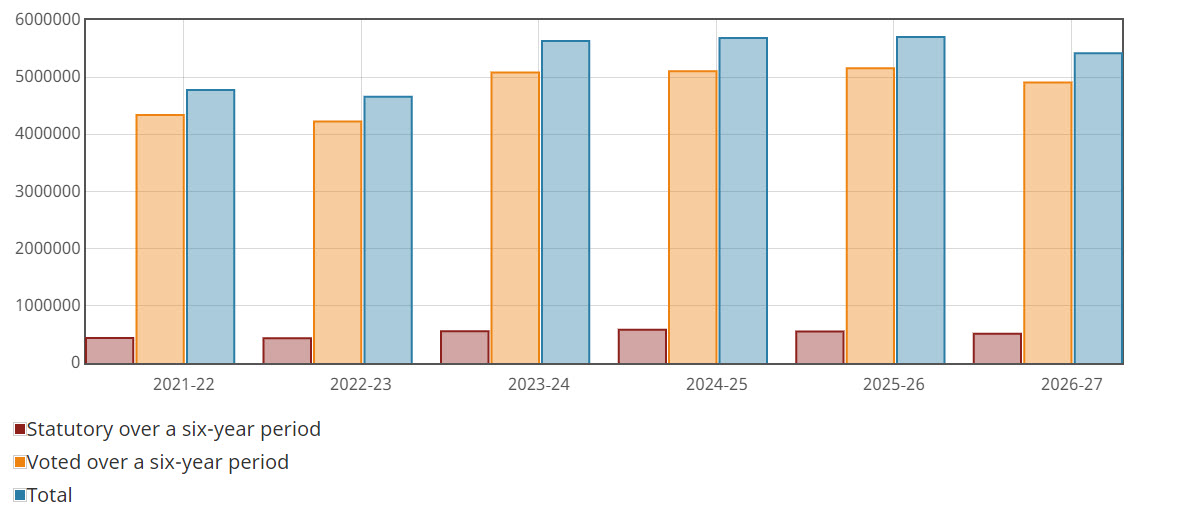
Table 8: Approved funding (statutory and voted) over a six-year period
| Year | 2021‑22 | 2022‑23 | 2023‑24 | 2024‑25 | 2025‑26 | 2026‑27 |
|---|---|---|---|---|---|---|
| Statutory over a six-year period | 438,567 | 434,668 | 553,222 | 583,010 | 549,385 | 509,487 |
| Voted over a six-year period | 4,336,250 | 4,223,825 | 5,081,060 | 5,101,677 | 5,154,754 | 4,908,296 |
| Total | 4,774,817 | 4,658,493 | 5,634,282 | 5,684,687 | 5,704,139 | 5,417,783 |
Analysis of statutory and voted funding over a six-year period
The graph above demonstrates a significant increase in expenditures in 2023-24 compared to the previous two years. This increase was expected, as we have seen a rise in both the number and complexity of complaints in recent years. A 300K fund transfer was received in 2023-24 from DND allowing the MPCC to break even. A 250K permanent transfer also took place starting in 2024-25, along with a temporary transfer of $250K for both fiscal years 2024-25 and 2025-26. This funding will allow the MPCC to maintain 2023-24 spending levels, however we will continue to monitor whether this funding is enough to allow the MPCC to deliver on its mandate. It is anticipated that additional human resources will be needed to carry out its mandate.
For further information on the MPCC’s departmental voted and statutory expenditures, consult the Public Accounts of Canada.
Financial statement highlights
MPCC’s complete financial statements (unaudited or audited) for the year ended March 31, 2024, are available online.
Table 9 Condensed Statement of Operations (unaudited or audited) for the year ended March 31, 2024 (dollars)
Table 9 summarizes the expenses and revenues for 2023–24 which net to the cost of operations before government funding and transfers.
| Financial information | 2023–24 actual results | 2023–24 planned results | Difference (actual results minus planned) |
|---|---|---|---|
| Total expenses | 6,145,525 | 5,142,171 | 1,003,354 |
| Total revenues | 0 | 0 | 0 |
| Net cost of operations before government funding and transfers | 6,145,525 | 5,142,171 | 1,003,354 |
The 2023–24 planned results information is provided in the MPCC’s Future-Oriented Statement of Operations and Notes 2023–24.
Table 10 summarizes actual expenses and revenues which net to the cost of operations before government funding and transfers.
| Financial information | 2023–24 actual results | 2022–23 actual results | Difference (2023-24 minus 2022-23) |
|---|---|---|---|
| Total expenses | 6,145,525 | 4,982,809 | 1,162,716 |
| Total revenues | 0 | 0 | 0 |
| Net cost of operations before government funding and transfers | 6,145,525 | 4,982,809 | 1,162,716 |
There was a significant difference in the MPCC’s 2023-24 actual results compared to the year prior. The largest increases in expenses occurred in salaries and professional services. Both these increases can be attributed to the increase in the number and complexity of complaint files, which led the MPCC to quickly backfill and hire additional employees. For this same reason, we also saw a significant increase between its actual results and the planned results, which were forecasted more than a year prior.
Table 11 Condensed Statement of Financial Position (unaudited or audited) as of March 31, 2024 (dollars)
Table 11 provides a brief snapshot of the department’s liabilities (what it owes) and assets (what the department owns), which helps to indicate its ability to carry out programs and services.
| Financial information | Actual fiscal year (2023–24) |
Previous fiscal year (2022–23) |
Difference (2023–24 minus 2022–23) |
|---|---|---|---|
| Total net liabilities | 833,863 | 739,270 | 94,593 |
| Total net financial assets | 521,851 | 460,860 | 60,991 |
| Departmental net debt | 312,012 | 278,410 | 33,602 |
| Total non-financial assets | 342,379 | 498,550 | (156,171) |
| Departmental net financial position | 30,367 | 220,140 | (189,773) |
Human resources
This section presents an overview of the department’s actual and planned human resources from 2021–22 to 2026–27.
Table 12: Actual human resources for core responsibilities and internal services
Table 12 shows a summary of human resources, in full-time equivalents (FTEs), for the MPCC’s core responsibilities and for its internal services for the previous three fiscal years.
| Core responsibilities and internal services | 2021–22 actual FTEs | 2022–23 actual FTEs | 2023–24 actual FTEs |
|---|---|---|---|
| Independent Oversight of the Military Police | 16 | 14 | 15 |
| Subtotal | 16 | 14 | 15 |
| Internal services | 14 | 15 | 16 |
| Total | 30 | 29 | 31 |
Analysis of human resources over the last three years
The MPCC's full-time equivalents count has remained stable over the past few years, evenly divided between its one core responsibility and internal services.
Table 13: Human resources planning summary for core responsibilities and internal services
Table 13 shows information on human resources, in full-time equivalents (FTEs), for each of the MPCC’s core responsibilities and for its internal services planned for the next three years. Human resources for the current fiscal year are forecasted based on year to date.
| Core responsibilities and internal services | 2024–25 planned FTEs | 2025–26 planned FTEs | 2026–27 planned FTEs |
|---|---|---|---|
| Independent Oversight of the Military Police | 16 | 16 | 16 |
| Subtotal | 16 | 16 | 16 |
| Internal services | 15 | 15 | 15 |
| Total | 31 | 31 | 31 |
Analysis of human resources for the next three years
With the sharp increase in the number and complexity of complaints within the last few years, the MPCC needs to add more human resources to an overtaxed system to maintain efficiency and timeliness of the complaints process. The MPCC will continue to monitor funding availability to determine if additional human resources can be supported in the future.
Corporate Information
Departmental profile
Appropriate minister(s): The Honourable Bill Blair, Minister of National Defence
Institutional head: Me Tammy Tremblay, Chairperson
Ministerial portfolio: National Defence Portfolio
Enabling instrument(s): Part IV of the National Defence Act,
Year of incorporation / commencement: 1998
Other: For more information, please visit the MPCC website.
Departmental contact information
Mailing address:
270 Albert Street, 10th Floor
Ottawa, ON K1P 5G8
Canada
Contact us to schedule a private consultation.
Telephone: : 613-947-5625 or toll free at 1-800-632-0566
Email: commission@mpcc-cppm.gc.ca
Website(s): mpcc-cppm.gc.ca
Supplementary information tables
The following supplementary information tables are available on the MPCC's website.
- Gender-Based Analysis Plus
- Response to Parliamentary committees and external audits
Information on the MPCC’s United Nations 2030 Agenda for Sustainable Development can be found on the MPCC’s website in the report Departmental Sustainable Development Strategy.
Federal tax expenditures
The tax system can be used to achieve public policy objectives through the application of special measures such as low tax rates, exemptions, deductions, deferrals and credits. The Department of Finance Canada publishes cost estimates and projections for these measures each year in the Report on Federal Tax Expenditures. This report also provides detailed background information on tax expenditures, including descriptions, objectives, historical information and references to related federal spending programs as well as evaluations and GBA Plus of tax expenditures.
Definitions
- appropriation (crédit)
- Any authority of Parliament to pay money out of the Consolidated Revenue Fund.
- budgetary expenditures (dépenses budgétaires)
- Operating and capital expenditures; transfer payments to other levels of government, departments or individuals; and payments to Crown corporations.
- core responsibility (responsabilité essentielle)
- An enduring function or role performed by a department. The intentions of the department with respect to a core responsibility are reflected in one or more related departmental results that the department seeks to contribute to or influence.
- Departmental Plan (plan ministériel)
- A report on the plans and expected performance of an appropriated department over a 3 year period. Departmental Plans are usually tabled in Parliament each spring.
- departmental priority (priorité)
- A plan or project that a department has chosen to focus and report on during the planning period. Priorities represent the things that are most important or what must be done first to support the achievement of the desired departmental results.
- departmental result (résultat ministériel)
- A consequence or outcome that a department seeks to achieve. A departmental result is often outside departments' immediate control, but it should be influenced by program-level outcomes.
- departmental result indicator (indicateur de résultat ministériel)
- A quantitative measure of progress on a departmental result.
- departmental results framework (cadre ministériel des résultats)
- A framework that connects the department's core responsibilities to its departmental results and departmental result indicators.
- Departmental Results Report (rapport sur les résultats ministériels)
- A report on a department's actual accomplishments against the plans, priorities and expected results set out in the corresponding Departmental Plan.
- full-time equivalent (équivalent temps plein)
- A measure of the extent to which an employee represents a full person-year charge against a departmental budget. For a particular position, the full-time equivalent figure is the ratio of number of hours the person actually works divided by the standard number of hours set out in the person's collective agreement.
- gender-Based Analysis Plus (GBA Plus) (analyse comparative entre les sexes plus [ACS Plus])
- An analytical tool used to assess support the development of responsive and inclusive how different groups of women, men and gender-diverse people experience policies, programs and policies, programs, and other initiatives. GBA Plus is a process for understanding who is impacted by the issue or opportunity being addressed by the initiative; identifying how the initiative could be tailored to meet diverse needs of the people most impacted; and anticipating and mitigating any barriers to accessing or benefitting from the initiative. GBA Plus is an intersectional analysis that goes beyond biological (sex) and socio-cultural (gender) differences to consider other factors, such as age, disability, education, ethnicity, economic status, geography (including rurality), language, race, religion, and sexual orientation.
- government-wide priorities (priorités pangouvernementales)
- For the purpose of the 2023–24 Departmental Results Report, government-wide priorities are the high-level themes outlining the government’s agenda in the November 23, 2021, Speech from the Throne: building a healthier today and tomorrow; growing a more resilient economy; bolder climate action; fight harder for safer communities; standing up for diversity and inclusion; moving faster on the path to reconciliation; and fighting for a secure, just and equitable world.
- horizontal initiative (initiative horizontale)
- An initiative where two or more federal departments are given funding to pursue a shared outcome, often linked to a government priority.
- non budgetary expenditures (dépenses non budgétaires)
- Net outlays and receipts related to loans, investments and advances, which change the composition of the financial assets of the Government of Canada.
- performance (rendement)
- What a department did with its resources to achieve its results, how well those results compare to what the department intended to achieve, and how well lessons learned have been identified.
- performance indicator (indicateur de rendement)
- A qualitative or quantitative means of measuring an output or outcome, with the intention of gauging the performance of an department, program, policy or initiative respecting expected results.
- plan (plan)
- The articulation of strategic choices, which provides information on how a department intends to achieve its priorities and associated results. Generally, a plan will explain the logic behind the strategies chosen and tend to focus on actions that lead to the expected result.
- planned spending (dépenses prévues)
- For Departmental Plans and Departmental Results Reports, planned spending refers to those amounts presented in Main Estimates.
- A department is expected to be aware of the authorities that it has sought and received. The determination of planned spending is a departmental responsibility, and departments must be able to defend the expenditure and accrual numbers presented in their Departmental Plans and Departmental Results Reports.
- program (programme)
- Individual or groups of services, activities or combinations thereof that are managed together within the department and focus on a specific set of outputs, outcomes or service levels.
- program inventory (répertoire des programmes)
- Identifies all the department’s programs and describes how resources are organized to contribute to the department’s core responsibilities and results.
- result (résultat)
- A consequence attributed, in part, to an department, policy, program or initiative. Results are not within the control of a single department, policy, program or initiative; instead they are within the area of the department’s influence.
- Indigenous business (entreprise autochtone)
- For the purpose of the Directive on the Management of Procurement Appendix E: Mandatory Procedures for Contracts Awarded to Indigenous Businesses and the Government of Canada’s commitment that a mandatory minimum target of 5% of the total value of contracts is awarded to Indigenous businesses, a department that meets the definition and requirements as defined by the Indigenous Business Directory.
- statutory expenditures (dépenses législatives)
- Expenditures that Parliament has approved through legislation other than appropriation acts. The legislation sets out the purpose of the expenditures and the terms and conditions under which they may be made.
- target (cible)
- A measurable performance or success level that a department, program or initiative plans to achieve within a specified time period. Targets can be either quantitative or qualitative.
- voted expenditures (dépenses votées)
- Expenditures that Parliament approves annually through an appropriation act. The vote wording becomes the governing conditions under which these expenditures may be made.
- Date modified: