2025 Annual Report

____________________________
© His Majesty the King in Right of Canada, represented by the Military Police Complaints Commission of Canada, 2025.
Catalogue No. DP1E‑PDF | ISSN 1910‑8230
Table of Contents
- Message From the Chairperson
- Organizational Information
- The Complaints Process
- Year in Review – Operations
- Year in Review – Corporate Services
- Corporate Information
Message From the Chairperson

I am pleased to present the 2025 Annual Report for the Military Police Complaints Commission of Canada (MPCC). This report highlights the MPCC's achievements in delivering independent civilian oversight of the military police and outlines the challenges encountered this year in ensuring accountability within the military police.
Oversight Results and Activities
In 2025, the MPCC issued 12 Final Reports addressing allegations of military police misconduct or interference in military police investigations. The MPCC also conducted 8 Public Interest Investigations into serious matters including sexual misconduct, arson, and attempted murder and made 59 recommendations aimed at strengthening military policing.
For the first time in 14 years the MPCC convened, not one, but two public interest hearings to address matters raising significant concerns about military policing. The Orton Public Interest Hearing (MPCC-2024‑037) examines allegations that military police were negligent in responding to a welfare check during which the complainant’s husband was later found to have died by suicide. This case raises important questions about military police readiness and their capacity to respond in situations involving vulnerabilized individuals.
The Goulet Public Interest Hearing (MPCC-2024‑051) focuses on the alleged detention and mistreatment of a racialized civilian employee during an active‑shooter exercise. The case raises broader systemic concerns related to police use of force and potential racial profiling. Both hearings are ongoing and will continue into 2026.
Progress and Persistent Challenges
Throughout the year, the MPCC observed progress in several aspects of the oversight process involving the Canadian Forces Provost Marshal (CFPM), including improvements in reporting practices, timeliness, and the use of informal resolution. These developments signal a welcome shift toward greater transparency and responsiveness within the military police complaints system.
However, significant challenges persist. Issues related to disclosure, the narrow interpretation of the MPCC’s mandate, inadequate or lack of responses to recommendations, and investigative practices within the office of Professional Standards of the CFPM continue to impede the effectiveness of the oversight framework established by Parliament. While these developments do not alter our commitment to independent oversight, they do raise concerns about the long-term effectiveness of the current legislative framework and underscore the need for a modernized legislative structure capable of supporting robust, independent oversight in the long term.
Oversight is not a Threat; it is a Cornerstone of Democracy
To address these risks, the MPCC has taken proactive steps, including litigation and the development of a proposed bill to modernize military police oversight. In 2025, the MPCC submitted comprehensive legislative reform packages first to the Minister of Defence, the Honourable Bill Blair, and then to his successor, the Honourable David J. McGuinty. As I have explained at length in the past two Annual Reports, the need for legislative modernization is well‑established:
-
No Significant Changes since 1999: There have been no significant changes to improve civilian oversight of the military police since 1999. This stagnation has left the oversight system outdated and ineffective in addressing current challenges.
-
Lack of Appropriate Powers: The MPCC lacks essential powers to fulfill its mandate, such as subpoena power except in public interest hearings. These limitations hamper the MPCC's ability to conduct thorough and effective investigations.
-
Non-Compliance with Existing Legislation: Even the minimal current provisions of the National Defence Act are sometimes not respected, rendering the system ineffective.
-
Erosion of Public Trust: Further delays in implementing necessary reforms risk eroding public confidence in Government institutions and Canada’s civilian oversight regime for the military police.
The legislative proposal builds on recommendations made by former Supreme Court of Canada Justice Morris Fish and on the MPCC’s own institutional experience over the past 26 years. The goal is simple: to make oversight clearer, stronger, and more effective against non-compliance. We look forward to engaging with the current Minister on this important initiative.
We continue to maintain professional working relationships at many levels of the military police structure and recognize the dedication and professionalism of countless individual military police members who serve with integrity. While misconduct does occur, it is not representative of the majority. Most of the concerns I raise in this report are not directed at individual military police officers, but rather at leadership and systemic issues that shape police accountability and culture. Ultimately, institutions are judged not only by the professionalism of their members, but by how they respond to scrutiny, especially in difficult moments. When harm has occurred, when lives have been lost, or when systemic issues are identified, the response cannot be silence or retreat into legalism. Oversight is not a threat. It is a pillar of trust, and a cornerstone of democracy.
Excellence in Workplace Culture
This year, the MPCC was proud to be ranked No. 2 on the Best Public Service Workplaces 2025 list, as reported by the Ottawa Citizen in November 2025, placing the MPCC among the top federal workplaces out of 85 organizations evaluated. We were equally pleased with the MPCC’s strong participation and excellent results in the 2024 Public Service Employee Survey, particularly in the areas of respect, diversity, and overall satisfaction. As the pace and complexity of our work continue to grow, ensuring that employees feel valued, supported, and empowered remains a central priority.
Recognizing that a strong workplace is built on both culture and representation, the MPCC continued to prioritize attracting and retaining talented professionals who reflect the diversity of Canada. This year, the MPCC is proud to report that its workforce achieves full representation across all designated employment equity groups. Notably, 27% of employees identify as members of a visible minority and 14% as persons with disabilities, both surpassing the aggregated workforce availability estimates for these designated employment equity groups. In addition to these internal achievements, the MPCC is also proud to report that 25.47% of its contracts this year were awarded to Indigenous companies, far exceeding the initial target of 5%.These results underscore our commitment to building a workplace where people not only feel valued and supported, but also see themselves reflected in the organization they serve.
These achievements reflect the dedication and professionalism of every member of the MPCC team. I am inspired by their commitment to excellence, innovation, and public service. It is through their expertise and integrity that we continue to fulfill our mandate and serve Canadians effectively and with purpose.
Finally, I want to acknowledge the members of the public, complainants, and military police members who entrust us with their concerns. Their willingness to come forward is essential to effective oversight, and we remain committed to examining every complaint with diligence, fairness, and respect.
Organizational Information
The MPCC is an administrative tribunal created by Parliament to provide independent, civilian oversight of the Canadian Forces Military Police.
Mission
To promote and ensure the highest standards of conduct by the military police, to deter interference in military police investigations and to enhance public confidence in military policing.
Vision
To be an authority on independent civilian oversight of the police by providing an impartial, accessible and efficient complaints process.
Mandate
The MPCC’s mandate is set out in Part IV of the National Defence Act, which provides the following powers:
- monitoring investigations by the Canadian Forces Provost Marshal of military police members conduct complaints;
- reviewing disposition of conduct complaints about military police members, at the request of complainants;
- investigating complaints of interference made by military police members;
- conducting public interest investigations and hearings; and
- reporting findings and making recommendations directly to the military police and national defence leadership.
Values

Alternate format
The image shows a radial diagram illustrating the Military Police Complaints Commission of Canada’s values:
- Impartiality
- Independence
- Integrity
- Rigour
- Transparency
- Respect
- Inclusion
Organizational Chart
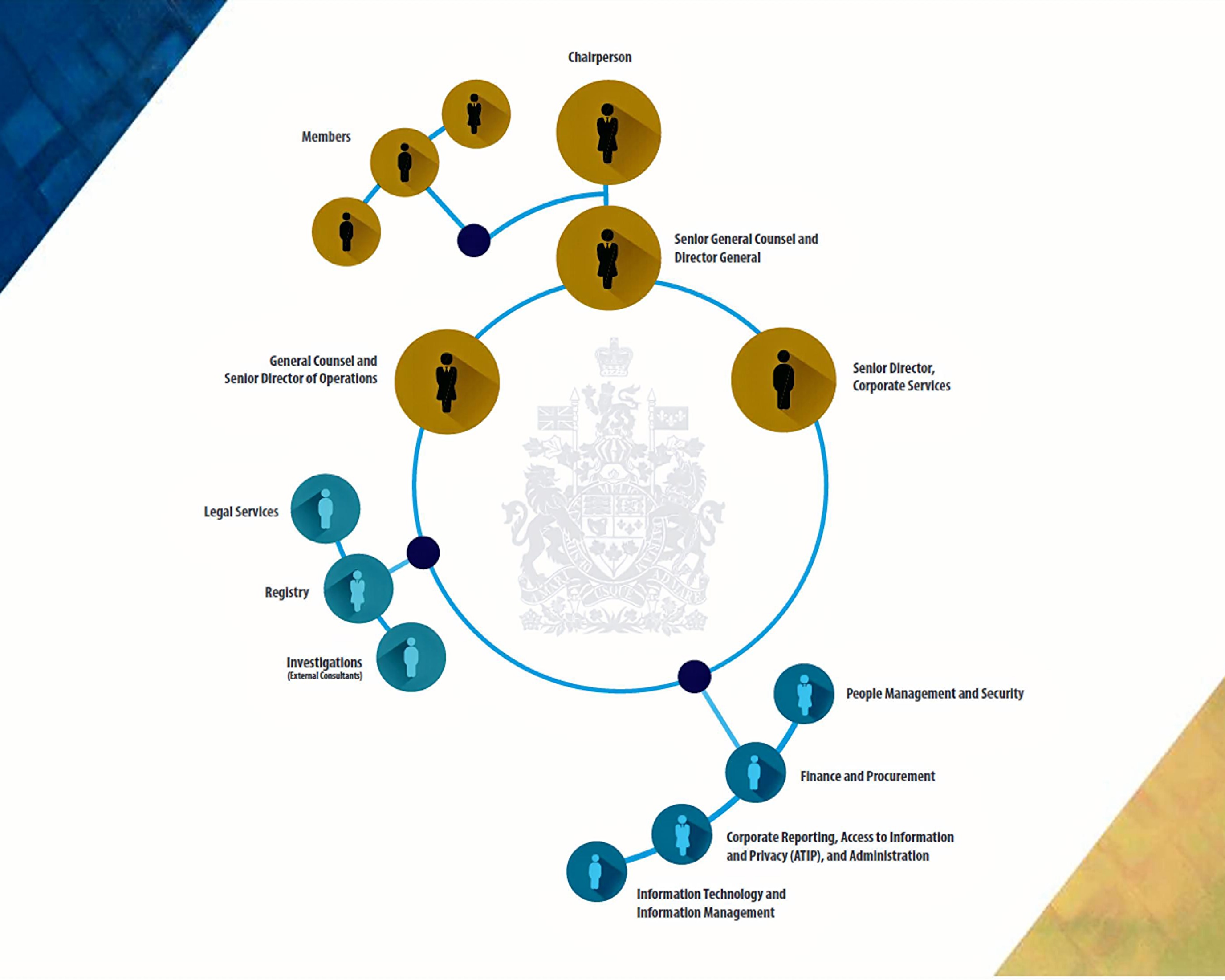
Alternate format
This is an image of an organizational chart showing the Military Police Complaints Commission of Canada’s (MPCC) organizational structure.
The MPCC is headed by the Chairperson.
The Senior General Counsel and Director General and the Members report directly to the Chairperson.
The General Counsel and Senior Director of Operations and the Senior Director of Corporate Services report to the Senior General Counsel and Director General.
The General Counsel and Senior Director of Operations manages:
- Legal Services
- Registry
- Investigations (External Consultants)
The Senior Director of Corporate Services manages:
- People Management and Security
- Finance and Procurement
- Corporate Reporting, Access to Information and Privacy (ATIP), and Administration
- Information Technology and Information Management
The Complaints Process
The MPCC has jurisdiction over two types of complaints: conduct complaints and interference complaints.
Conduct complaints
Any person may file a complaint about the misconduct of a member of the military police in the performance of their "policing duties or functions." These complaints are first handled by the CFPM, with the MPCC monitoring this process. The CFPM then submits the Final Report, and if the complainant is dissatisfied with the CFPM’s conclusion, they may refer the complaint to the MPCC for review. The MPCC will then receive a copy of all relevant documents, determine the scope of the review, i.e., whether an investigation is required, then make findings and recommendations in an Interim Report. The Interim Report is submitted to the Minister of National Defence, the Chief of the Defence Staff and the CFPM.
The MPCC then receives a Notice of Action from the CFPM, which is the Canadian Forces’ official response to the Interim Report. This describes the actions that have been or will be taken in response to the MPCC’s recommendations, if any. The Notice of Action must also include the reasons for not acting on a recommendation. After reviewing the Notice of Action, the MPCC issues its Final Report, which is provided to the complainant, the subject(s) of the complaint, the CFPM and other statutory recipients.
The diagram shows the steps in the process of handling a conduct complaint.
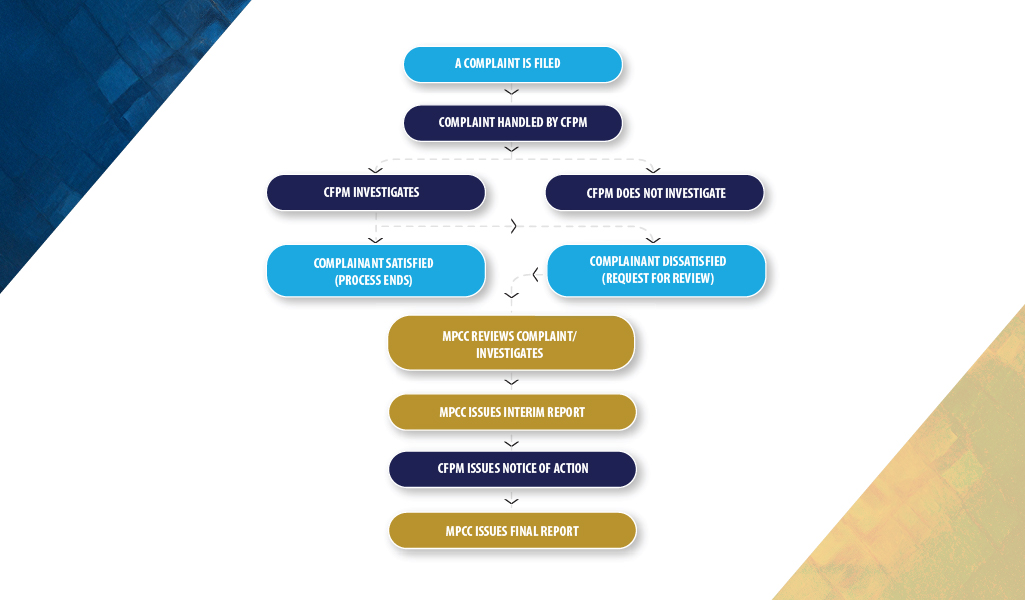
Alternate format
This is an image showing the steps in the process of handling a conduct complaint with the Military Police Complaints Commission of Canada:
- A complaint is filed
- Complaint handled by the CFPM
- CFPM investigates
- Complainant is satisfied (process ends)
- CFPM does not investigate
- Complainant dissatisfied (request for review)
- MPCC reviews complaint / investigates
- MPCC issues an interim report
- CFPM issues notice of action
- MPCC issues its final report
Interference Complaints
Only military police members conducting or supervising an investigation may file an interference complaint if they believe that a member of the Canadian Forces or a senior official of the Department of National Defence has interfered with or attempted to influence their investigation. Unlike conduct complaints, the MPCC has exclusive jurisdiction over interference complaints.
Following its investigation, the MPCC makes findings and recommendations in an Interim Report. This report is submitted to the Minister of National Defence, to the Chief of the Defence Staff (CDS) if the alleged interference was on the part of a member of the Canadian Forces, or to the Deputy Minister if the subject of the complaint is a senior official of the department, as well as to the Judge Advocate General and the CFPM.
The MPCC then receives the Notice of Action from the Chief of the Defence Staff or Deputy Minister, outlining what action, if any, has been or will be taken as a result of the MPCC’s recommendations. The Notice of Action must also include the reasons for not acting on a recommendation. The MPCC then issues its Final Report, which is provided to the complainant, the subject(s) of the complaint, the CFPM and other statutory recipients.
The diagram below outlines the steps involved in handling an interference complaint.
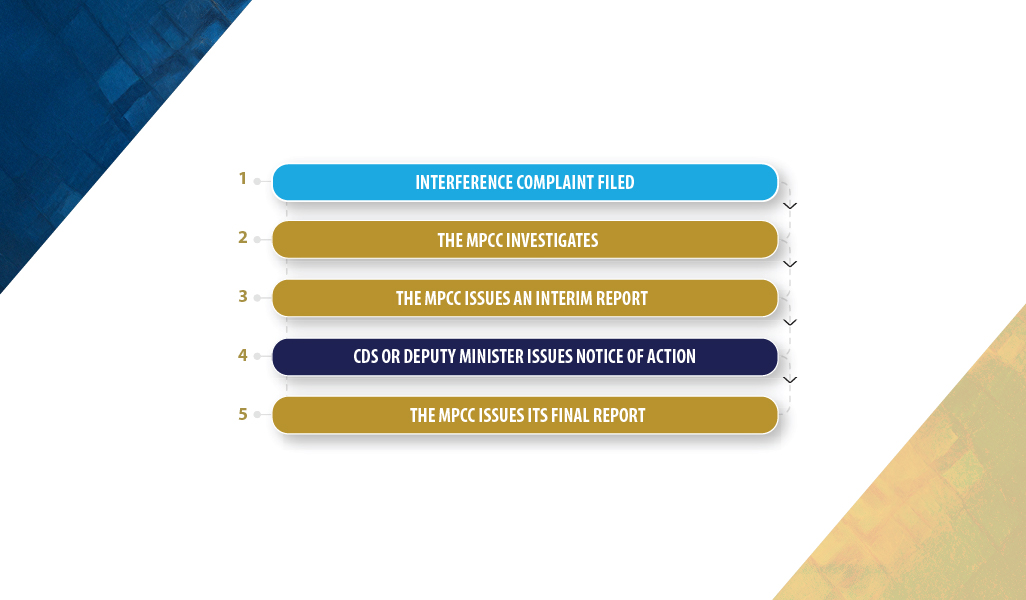
Alternate format
The diagram below outlines the steps involved in handling an interference complaint.
- Interference complaint filed
- The MPCC investigates
- The MPCC issues an interim report
- The CDS or Deputy Minister issues notice of action
- The MPCC issues its final report
Public Interest Investigations or Hearings
The Chairperson of the MPCC may also, at any time, cause a public interest investigation or hearing to be held into a complaint of misconduct or interference. The public interest investigation process allows the MPCC to directly investigate a conduct complaint as the initial step, rather than following the usual procedure in which the CFPM conducts the investigation first. At the conclusion of a public interest investigation or hearing, the MPCC makes all its findings and recommendations public by publishing its full Final Report on its website. The decision of whether the public interest would be served by the MPCC conducting a public interest investigation is made on a case-by-case basis.
The following factors, while not exhaustive, have been identified by the MPCC as relevant to decisions regarding the initiation of public interest investigations:
- The seriousness of the alleged conduct;
- The systemic issues raised in the complaint;
- The involvement of senior officials or military officers;
- Public interest in the issues related to the complaint; and
- Process considerations which suggest that it would be more fair, credible, coherent or efficient to deal with the complaint as a public interest case.
Further information on our complaints handling process can be found on our website in the following sections:
Year in Review – Operations
Statistics
The CFPM is generally responsible in the first instance for dealing with conduct complaints, except for complaints against them. A complainant who is dissatisfied with the CFPM’s handling of their complaint can refer the matter to the MPCC to review. Interference complaints are handled by the MPCC in the first instance.
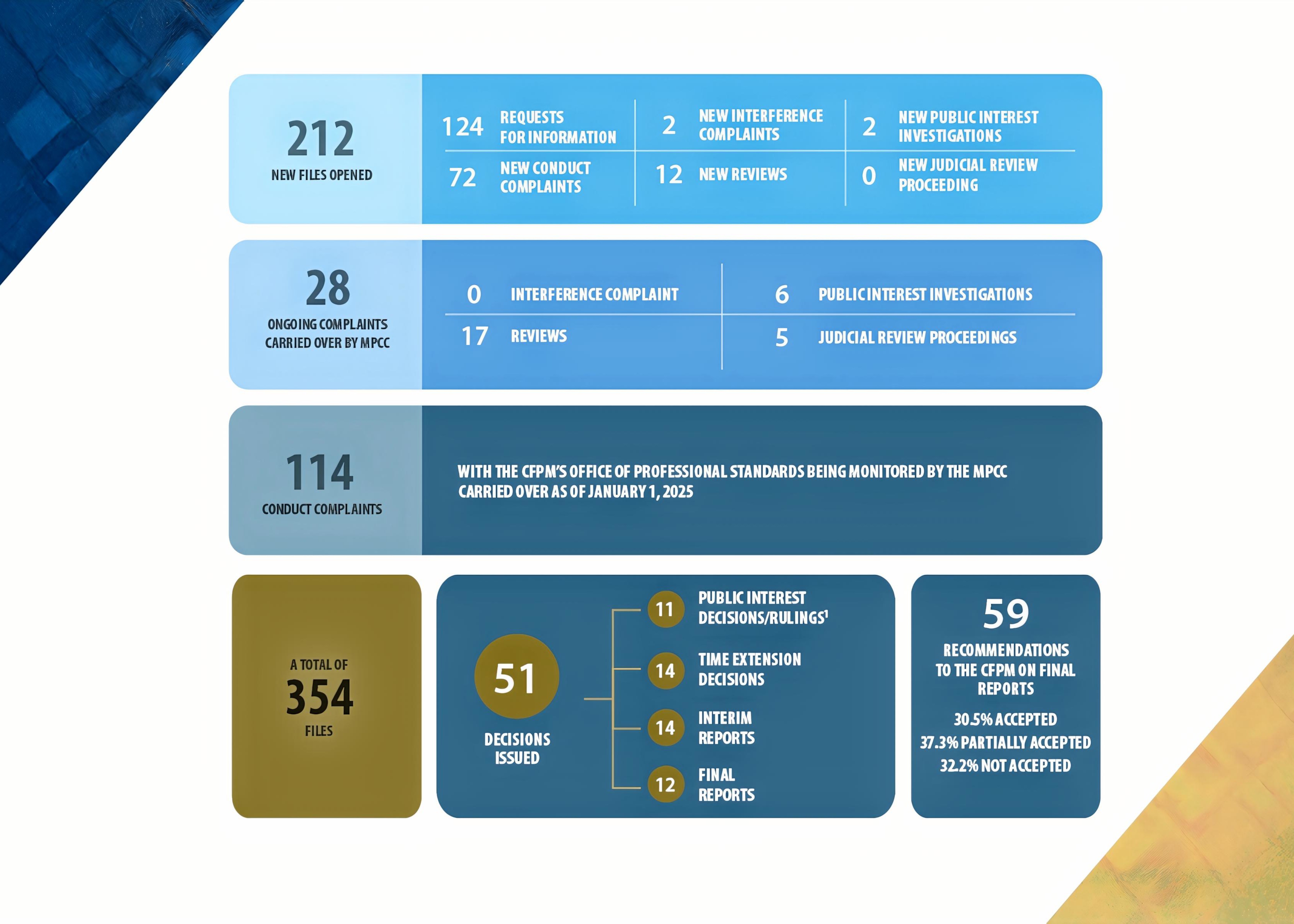
Alternate format
The image is that of a table showing the year in review in numbers for the Operations section of the Military Police Complaints Commission of Canada:
-
212 NEW FILES OPENED
- 124 requests for information
- 72 new conduct complaints
- 2 new interference complaints
- 12 new reviews
- 2 new public interest investigations
- 0 new judicial review proceedings
-
28 ONGOING COMPLAINTS CARRIED OVER BY MPCC
- 0 interference complaint
- 17 reviews
- 6 public interest investigations
- 5 judicial review proceedings
-
114 CONDUCT COMPLAINTS
- With the CFPM’s office of Professional Standards being monitored by the MPCC carried over as of January 1, 2025
- A TOTAL OF 354 FILES
-
51 DECISIONS ISSUED
- 11 public interest decisions/rulings Footnote 1
- 14 time extension decisions
- 14 interim reports
- 12 final reports
-
59 RECOMMENDATIONS TO THE CFPM ON FINAL REPORTS
- 30.5 % accepted
- 37.3 % partially accepted
- 32.2 % not accepted
The MPCC has observed a significant rise in the number of new conduct complaints over the past few years, resulting in a historically high workload associated with new complaints, carried over complaints and requests for information.
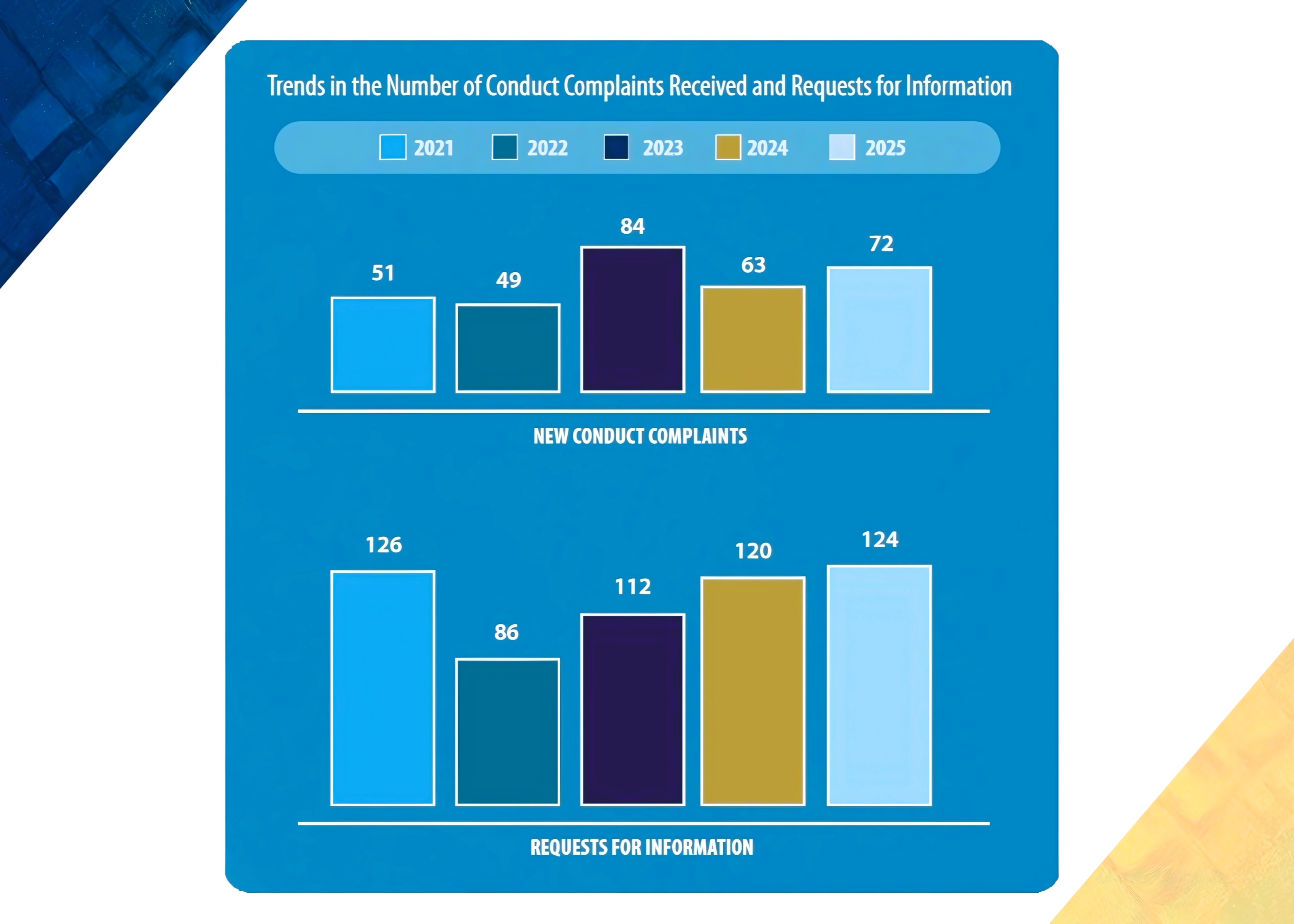
Alternate format
This is an image of a vertical bar chart entitled "Trends in the Number of Conduct Complaints Received and Requests for Information," displaying data from 2021 to 2025 for two categories: "New Conduct Complaints" and "Requests for Information."
The breakdown of the data is as follows:
-
New Conduct Complaints
- 2021: 51
- 2022: 49
- 2023: 84
- 2024: 63
- 2025: 72
-
Requests for information
- 2021: 126
- 2022: 86
- 2023: 112
- 2024: 120
- 2025: 124
Service Standards
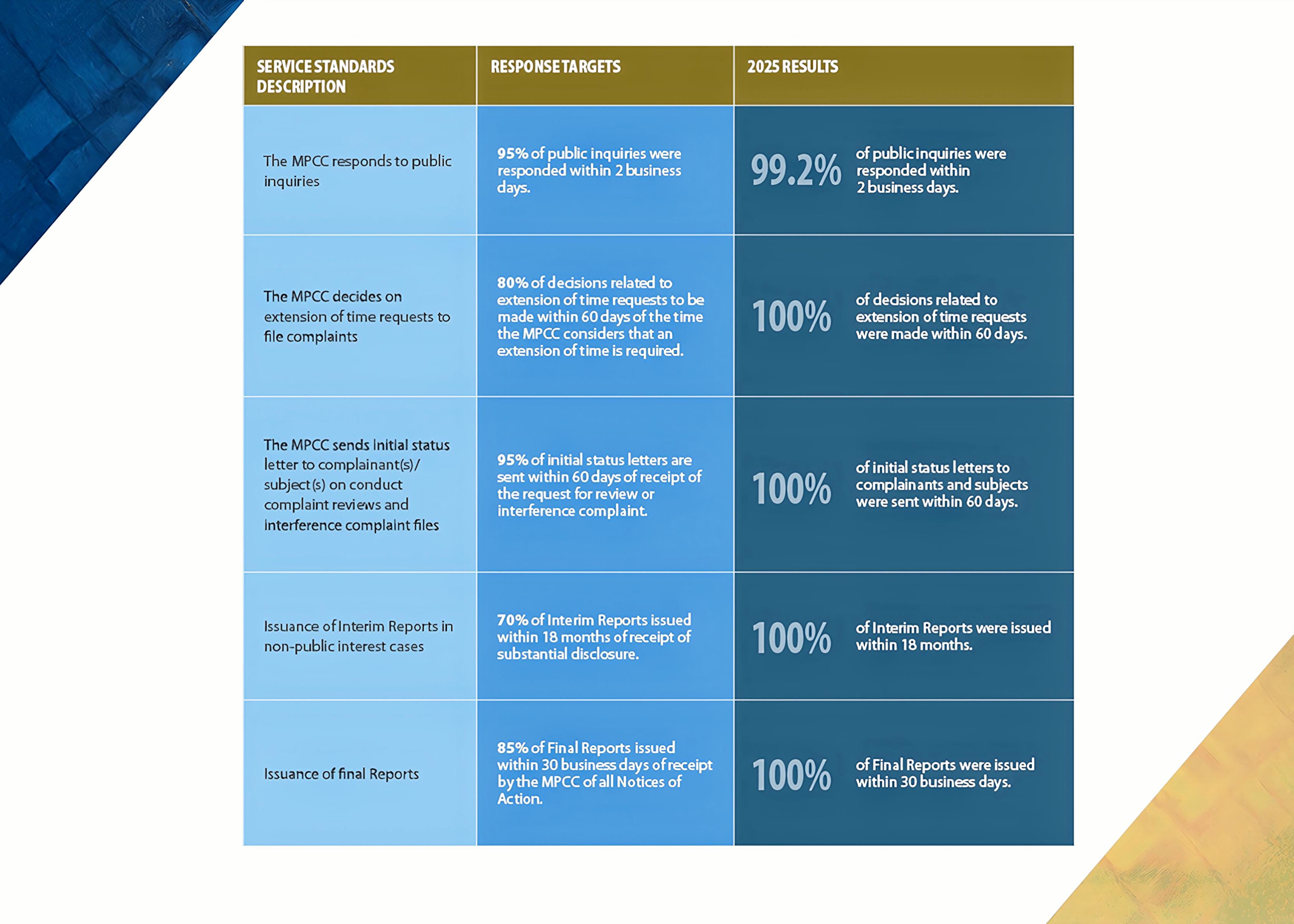
Alternate format
The image is that of a table showing the service standards of the Military Police Complaints Commission of Canada divided into three columns, with the following headings:
- Service Standards Description
- Response Targets
- 2025 Results
The table is divided into 5 lines, as follows:
Line 1
Service Standard Description: The MPCC responds to public inquiries.
Response Target: 95% of public inquiries were responded within 2 business days.
2025 Results: 99.2% of public inquiries were responded within the 2 business days.
Line 2
Service Standard Description: The MPCC decides on extension of time requests to file complaints.
Response Target: 80% of decisions related to extension of time requests to be made within 60 days of the time the MPCC considers that an extension of time is required.
2025 Results: 100% of decisions related to extension of time requests were made within 60 days.
Line 3
Service Standard Description: The MPCC sends initial status letter to complainant(s)/subject(s) on conduct complaint reviews and interference complaint files.
Response target: 95% of initial status letters are sent within 60 days of receipt of the request for review or interference complaint.
2025 Results: 100% of initial status letters to complainants and subjects were sent within 60 days.
Line 4
Service Standard Description: Issuance of interim reports in non-public interest cases.
Response target: 70% of interim reports issued within 18 months of receipt of substantial disclosure.
2025 Results: 100% of interim reports were issued within 18 months.
Line 5
Service Standard Description: Issuance of final reports.
Response target: 85% of final reports issued within 30 business days of receipt by the MPCC of all notices of action.
2025 Results: 100% of final reports were issued within 30 business days.
Progress and Persistent Challenges in Oversight
In 2025, the MPCC observed progress in several aspects of the oversight process involving the Office of the CFPM, including improvements in reporting practices, timeliness, and the use of informal resolution. These developments reflect a welcome shift toward greater transparency and responsiveness within the military police complaints system. At the same time, significant challenges persist. Ongoing issues related to disclosure, the narrow interpretation of the MPCC’s mandate, the adequacy of responses to recommendations, and investigative practices within the office of Professional Standards continue to impede the effectiveness of the oversight framework established by Parliament. The following section outlines both the positive steps taken and the areas where further action is required to ensure a robust, accountable, and effective military police accountability system.
Improvements
The MPCC has observed several improvements in the Office of the CFPM’s practices over the past year. In 2024, the MPCC raised serious concerns about complaints being shut down by the CFPM and redirected to other processes, without properly disposing of the underlying conduct complaint within the complaint system set up by Parliament for military police misconduct. Examples included cases where the complaints process was terminated by the CFPM and the matter referred for criminal investigation or a quality assurance review. These unilateral internal referrals excluded both the complainant and the MPCC from the process and failed to recognize that criminal investigations and quality assurance reviews are not the transparent civilian independent system established by Parliament to deal with allegations of military police misconduct as they serve distinct purposes from conduct complaint investigations. The MPCC did not observe further instances of such internal referrals in 2025.
The MPCC is also pleased that in 2025 the CFPM resumed monthly status reporting to parties, including cases where files are held in abeyance. This practice enhances transparency and keeps complainants informed of the progress of their complaint as prescribed by Parliament.
While timeliness remains a challenge for the office of the CFPM, the MPCC has noted improvement. The number of Professional Standards files exceeding one year has decreased from 76 to 51, indicating progress toward more timely resolution of complaints.
Professional Standards also made meaningful efforts to increase the use of informal resolution where appropriate and mutually agreed upon. Informal resolution can help parties better understand each other’s perspectives and often leads to faster, more constructive outcomes. The MPCC appreciates that the office of the Professional Standards continues to share the details of these resolutions with us.
Remaining Challenges
Despite these positive developments, several challenges continue to impede effective oversight:
Lack of Full Disclosure of Information
Full disclosure of military police files is essential for the MPCC to fulfill its statutory mandate. Although fewer disclosure issues arose in 2025 compared to 2024, concerns remain:
- Over‑redaction of personal information continues to be a recurring problem, undermining transparency and the credibility of oversight. The MPCC maintains that only information protected by solicitor‑client privilege should be redacted. In some cases, the MPCC has successfully obtained less‑redacted versions of files after they were initially provided with excessive number of redactions. This is a positive development.
- Despite receiving additional material in the House Fire – Attempted Murder Public Interest Investigation, the MPCC remains before the Federal Court (since 2023) in disputes with the CFPM over disclosure in that matter and in two conduct complaint reviews.
- Delayed disclosure also remains an issue. In the Orton case (now a public interest hearing), despite the MPCC’s formal request for disclosure in October 2024, the relevant materials were not provided until July 2025. Even then, production occurred only after the MPCC issued a summons. This nine‑month delay not only impeded the MPCC’s investigative progress but also undermined procedural efficiency, increased costs, and contributed to the avoidable prolongation of the complaint process.
- The CFPM has also declined to provide disclosure at the preliminary stage when the MPCC is determining whether to call a public interest investigation or hearing, which represents a change of position from previous years. While the CFPM’s office of Professional Standards has indicated that there is no legislative requirement to provide this information, neither is there any legal impediment to doing so. Moreover, efficient and strategic use of public interest investigations and hearings is in the CFPM’s interest; however this reluctance to share information early in the process creates a significant barrier to effective oversight.
- Public interest investigations and hearings require substantial time, staffing, and financial resources, and the MPCC must be able to assess, on the basis of reliable and complete information, whether such proceedings are warranted. Without timely preliminary disclosure, the MPCC is forced to make these threshold decisions with an incomplete evidentiary picture, increasing the risk of either launching an unnecessarily resource‑intensive process or, conversely, delaying action in matters that merit heightened scrutiny. Early disclosure would not only support more efficient decision‑making but would also promote transparency, reduce procedural delays, and strengthen public confidence in the oversight framework.
Restrictive Interpretation of MPCC’s Mandate
Effective oversight requires a broad interpretation of the MPCC’s statutory mandate, which is designed to uphold high standards of military police conduct, prevent interference, and maintain public confidence. However, the CFPM frequently disputes the MPCC’s interpretation of what constitutes “policing duties or functions,” which defines the scope of conduct subject to complaint. Even more troubling, the CFPM often does not even give the MPCC an opportunity to make this determination; instead, once they have reached their own conclusion that the complaint does not relate to “policing duties or functions,” they classify the matter as not being a “complaint” and, on that basis, deny disclosure to the MPCC. The MPCC continues to view Part IV of the National Defence Act as remedial legislation that should be interpreted liberally.
Although disputes have decreased compared to the previous year, disagreements with the CFPM regarding the validity of complaints, particularly those involving Professional Standards and the CFPM’s handling of conduct complaints, including respecting the mandatory timeframe prescribed by the National Defence Act, persist. These issues remain before the Federal Court since 2023.
Refusal to Respond to Certain Recommendations
In conduct complaints involving the CFPM and in interference cases, the Chief of the Defence Staff is responsible for issuing the Notice of Action in response to the MPCC’s Interim Report. However, recommendations are often directed to the CFPM as the chief of the military police, and the only person in the Canadian Forces who can direct the military police. In several cases this year involving delays in Professional Standards investigations, the CFPM declined to respond to recommendations directed to her, citing the absence of a statutory obligation. While the Act could be clearer, it is unlikely that Parliament intended for MPCC recommendations to go unanswered by the only statutory actor capable of operationally implementing them, an outcome that would be absurd. Moreover, even if no explicit legal duty exists, nothing prevents the CFPM from responding. Declining to do so undermines transparency, particularly for those affected by the complaints, and runs contrary to the spirit of the oversight framework established by Parliament.
Inadequate Responses to MPCC Recommendations
The MPCC acknowledges the CFPM’s efforts to issue Notices of Action within 90 days. However, recent responses often lack the detail necessary to understand what actions, if any, will be taken. Many responses are non‑committal or do not meaningfully address the recommendations.
For example, in the Fortin Public Interest Investigation, in response to MPCC recommendations for specific changes to Military Police Orders the CFPM responded: “Action to be taken. Military police policy/procedures to be reviewed and updated as applicable based on Canadian best policing practices.” Such a response does not indicate whether the proposed reform will be made or not. While many of the CFPM’s comments expressed a general intent to align military police policies and procedures with Canadian best policing practices, they lacked specificity. The responses did not clearly identify which police policies and procedures would be reviewed, nor did they explain how proposed updates would reflect the recommendations. They also did not acknowledge that the MPCC’s recommendations themselves were grounded in recognized best practices in Canadian policing. Several responses address recommendations only in part, leaving critical gaps, and failing to provide meaningful or complete answers. A more comprehensive and transparent response to each element of every recommendation would have better demonstrated institutional accountability and willingness to implement meaningful changes, key features of the oversight and accountability system established by Parliament. This, combined with the earlier decision by the CFPM to refuse to provide updates on the implementation of recommendations, means that complainants and Canadians are left in the dark about implementation.
Similarly in conduct complaint review file MPCC-2021-010—where the MPCC found improper detention, handcuffing, and racial profiling—the CFPM accepted only 5 of 20 recommendations in full. The Notice of Action provided vague or insufficient responses to many recommendations, despite the need expressed in the report for systemic safeguards against racial profiling, such as clear policies, training, supervision, and corrective action. While the CFPM expressed a general intent to align with Canadian best policing practices, this is already an expected standard and does not demonstrate which concrete steps will be taken.
Professional Standards Investigations
In addition to ongoing concerns about timeliness, the MPCC has observed that the CFPM’s office of Professional Standards continues at times to avoid interviewing complainants when investigating complaints in the first instance. Instead, investigators rely solely on the written complaint while conducting interviews only with the subject military police members. This imbalance results in missed opportunities to clarify or corroborate the complainant’s allegations and prevents complainants from responding to information that may appear inconsistent with their account.
This practice is neither user‑centric nor trauma‑informed. A user‑centric approach requires meaningful engagement with the person who experienced the alleged conduct, ensuring they have a fair opportunity to explain their perspective and feel heard throughout the process. A trauma‑informed approach recognizes that individuals, particularly those with trauma, may communicate more fully and accurately in a supportive, interactive setting rather than through a written statement alone. By not engaging with complainants, the office of Professional Standards misses an opportunity to address concerns early on and to build understanding and trust.
The issue is especially concerning in cases involving allegations of discrimination or racial profiling, several of which are currently under MPCC review. Failing to interview complainants contributes to perceptions that their concerns have not been taken seriously and increases the likelihood that they will be dissatisfied with the outcome and seek an MPCC review.
Inadequate Justification and Clarity in Professional Standards Decisions
The MPCC has raised concerns with the CFPM’s office of Professional Standards about the clarity of their decisions. It is a foundational principle of administrative law that decision‑makers must clearly explain the reasons for their conclusions so that parties can understand how the outcome was reached. As the Supreme Court of Canada emphasized in Canada (Minister of Citizenship and Immigration) v. Vavilov, decision‑makers are expected to adopt a “culture of justification.” Current Professional Standards reports do not consistently meet this standard. When complainants cannot understand why their allegations were found to be unsubstantiated, dissatisfaction increases and MPCC review becomes more likely.
Some Professional Standards reports also continue to reference a “clear and convincing evidence” standard. The Supreme Court of Canada has confirmed in FH v. McDougall that the only standard of proof in civil and administrative matters is the balance of probabilities. Although Professional Standards reports do claim to apply the balance of probabilities, the additional reference in certain cases to “clear and convincing evidence” suggests an improperly elevated evidentiary threshold and risks confusing complainants and subject members.
These concerns have been further compounded by the recently revised reporting format used to communicate investigation results to complainants, subject members, and the MPCC. The new format is more difficult to follow, often omitting a clear narrative and presenting evidence in the order it was gathered rather than in a coherent chronology. More importantly, the structure obscures the rationale for the findings. The findings section typically consists of brief, conclusory statements that refer back to the investigation summary without clearly explaining the reasoning that supports each conclusion.
Responding to Systemic Issues
Public Interest Hearings
Sometimes a public interest hearing is the most transparent and effective way to ensure accountability and public trust. In 2025, the Chairperson of the MPCC initiated two public interest hearings to address matters raising significant concerns about military police conduct and broader systemic issues.
The first, the Orton Public Interest Hearing (MPCC-2024‑037), examines allegations that the military police were negligent in responding to a welfare check where the complainant’s husband was later found to have died by suicide. The case raises important questions about military police readiness and capacity to respond in such situations.
The second, the Goulet Public Interest Hearing (MPCC-2024‑051), focuses on the alleged detention and mistreatment of a racialized civilian employee during an active‑shooter exercise. The case raises broader systemic concerns, including police use of force and potentially racial profiling.
Both hearings are ongoing and will continue into 2026.
Litigation before the Federal Court
As discussed in this report, the MPCC has ongoing litigation before the Federal Court to challenge certain restrictive interpretations of the National Defence Act by the CFPM on disclosure obligations and jurisdiction. The MPCC anticipates that dates will be set for hearing in 2026 and looks forward to receiving judicial clarification on these areas of dispute.
Proactive Steps towards Legislative Reform
This marks the third consecutive Annual Report in which the MPCC has identified significant structural and operational challenges that impede the effective exercise of its statutory mandate. While the MPCC continues to work collaboratively with stakeholders and to address issues through individual investigations, public interest proceedings, and litigation, it is increasingly clear that certain barriers are rooted in the legislative framework itself.
Canada’s Military Police oversight needs an update. Here’s where to start.
The MPCC was created in 1999 to provide independent, civilian oversight of military policing. For over a quarter century, we have fulfilled that mandate with integrity, fairness, and diligence. But in recent years, our ability to do this work has been significantly hampered, not only by legislative gaps, but by increasingly entrenched institutional resistance.
Like other police oversight agencies in Canada, the MPCC needs the necessary tools and appropriate authority to conduct thorough investigations and perform its review and oversight roles effectively. Legislative reform is needed.
Escalating Barriers to Independent Civilian Oversight
As detailed in this annual report, the two precedent annual reports and as highlighted in our recent final report on the Major-General (MGen) (retired) Dany Fortin investigation, the MPCC has been encountering persistent and worsening challenges in carrying out its oversight responsibilities. These included:
- Delays and refusals by the CFPM to disclose relevant documents;
- Refusal to provide updates on implementation of recommendations
- Refusal to respond to MPCC recommendations.
- A narrowing interpretation of our jurisdiction by the CFPM; and
- Excluding complainants from meaningful updates or outcomes.
In some instances, these barriers have escalated from procedural resistance to outright refusal to comply with the oversight role that Parliament conferred on the MPCC. This is troubling.
Oversight Must Be Enforceable, Not Optional
Independent civilian oversight must be more than symbolic to be effective. It must have both independence and enforceability. While our legislative mandate remains clear under Part IV of the National Defence Act, some of its language leaves room for interpretation which sometimes has been leveraged not to protect the integrity of investigations, but rather to avoid them altogether.
In order to clarify and improve the law, in 2024, and again in 2025, the MPCC submitted comprehensive packages of proposed legislative reforms to both Ministers Blair and McGuinty. We look forward to discussing this initiative with the current Minister. These concrete proposals build upon recommendations made by former Supreme Court of Canada Justice Morris Fish, as well as our own institutional experience over the past quarter century. The goal is simple: to make oversight clearer, stronger, and more effective against non-compliance.
A central theme of the proposed bill is the modernization of legislative provisions governing the MPCC’s access to information necessary to perform its oversight role. Unlike the civilian oversight body for the Royal Canadian Mounted Police, whose information‑gathering authorities have been updated several times over the years, the MPCC’s statutory powers have not been revisited by Parliament since its creation in 1998. This is so despite the Third Independent Review of the National Defence Act, led by former Supreme Court of Canada Justice Morris Fish, explicitly calling for such reforms in 2021. The MPCC’s ability to access information it deems relevant to the complaints before it directly underpins the quality and credibility of the oversight which the MPCC provides to the military police which, in turn, is necessary for public confidence in Canadian military policing.
Bill C-11, An Act to amend the National Defence Act and other Acts, implements some of the 2021 Report by former Justice Fish of the Third Independent Review of the National Defence Act and the 2022 Report of the Independent External Comprehensive Review by former Justice Arbour. Unfortunately, Bill C-11 does not address the issues raised in the MPCC’s proposed draft Bill. Ultimately, what is needed is a disclosure regime which reflects the scope of the MPCC’s mandate, and which is transparent, reliable and predictable.
A Moment of Choice for the Canadian Forces
We continue to maintain professional working relationships at many levels of the military police structure. And we recognize the dedication and professionalism of countless individual military police members who serve with integrity.
But institutions must be judged not only by the actions of individuals, but by how they respond to scrutiny, especially in difficult moments. In cases where harm has occurred, when lives have been lost, or when systemic issues are identified, the response cannot be silence or retreat into legalism.
Oversight is not a threat. It is a pillar of trust, and a cornerstone of democracy.
The Path Forward
The Canadian public rightly expects its institutions, especially those entrusted with policing powers, to be accountable. The reforms we propose are not radical. The abilities to issue subpoenas and to have access to privileged information, for example, are necessary powers for an oversight body that must make findings of fact. Our proposed reforms are practical and in line with best practices in Canadian police oversight. And they are long overdue.
The MPCC remains ready and willing to fulfill its mandate. But we cannot do so effectively without an appropriate legal framework and a cultural environment that respects the spirit, not just the letter, of independent civilian oversight.
It is time for the Government to ensure that the MPCC has the tools necessary to hold the military police power to account in a meaningful way.
Decisions at a Glance
Public Interest Hearings and Investigations
The section below summarizes ongoing MPCC public interest hearings and investigations in 2025.
Orton Public Interest Hearing (MPCC-2024-037)
In May 2025, the MPCC announced that it would hold its first public interest hearing since 2011. Mrs. Orton’s complaint alleges that military police were negligent during a welfare check on Master Corporal (MCpl) Shaun Orton, who was later found to have died by suicide.
On April 21, 2024, Mrs. Orton reported disturbing communications from her husband and her concerns regarding his safety to the military police. She alleges that military police delayed initiating a welfare check. When they agreed to go to his house, she alleges that they delayed entering and then ultimately found MCpl Orton’s body. Ottawa Police Service was called and noted that MCpl Orton’s body was still warm and began CPR. He was then taken to hospital by ambulance and was later pronounced dead.
Mrs. Orton also alleges that military police misplaced MCpl Orton’s suicide note while removing her husband from the house. She complains that military police did not accompany her husband to the hospital or notify the complainant of his death. They did not take a noose or pills in the house as evidence. The complainant experienced numerous difficulties in obtaining information and updates from the military police. She also noted that the military police detachment Commanding Officer sent a priest to provide her with support without asking her permission and even though she had made known that she was Jewish.
Mrs. Orton filed a complaint with the CFPM’s office of Professional Standards on June 11, 2024 and just over a month later on July 30, 2024, the then Deputy Canadian Forces Provost Marshal (DCFPM) closed the file without investigating stating it was “more appropriately dealt through the ongoing criminal investigation…” pursuant to 250.28(2)(b) of the National Defence Act.
The MPCC Chairperson wrote to the then CFPM and asked him to reconsider the decision to close the file but on November 4, 2024, the then DCFPM declined to reconsider closing the complaint.
Meanwhile, the complainant requested that the MPCC review her complaint on September 25, 2024. The MPCC requested disclosure from the CFPM’s office of Professional Standards in early October. On November 4, the then DCFPM stated that disclosure would be held in abeyance because of the ongoing criminal investigation. The MPCC’s Chairperson wrote to the CFPM on November 18, again asking for disclosure, as there was no legal basis to hold disclosure in abeyance. The Chairperson offered to place the MPCC’s review into abeyance. The CFPM refused this disclosure request in December 2024.
The MPCC’s review was placed in abeyance as it continued to make periodic inquiries into the status of the criminal investigation. In late February 2025, the complainant advised the MPCC that the criminal investigation was complete. Following repeated inquiries, the MPCC received confirmation from the new CFPM that the investigation was concluded. The MPCC review was taken out of abeyance, and a third disclosure request was made. No disclosure was received by the date requested.
This complaint raises serious, systemic issues of public interest. Welfare checks by police are an important but difficult duty, and one that had already been the subject of recommendations from the MPCC in other files. Mental health challenges within the Canadian Forces are higher than those in the general population, and suicide prevention is a top Canadian Forces priority. The military police have a specific role in the policies in place to respond to suicide risk. For all of these reasons, the MPCC Chairperson declared this case a public interest hearing.
The MPCC issued a summons to the CFPM as a witness and required her to produce documentary evidence in relation to the hearing in June 2025. Disclosure was received in July 2025.
The MPCC also sought documentary evidence from other sources, including the OPS, the Ottawa Hospital, and the complainant.
In September 2025, the CFPM brought a motion requesting interested party status under s. 250.44(b) of the Act. In a decision dated November 13, 2025, the Chairperson denied this motion but granted the CFPM status as an intervenor.
A total of 4 allegations were noted in this complaint, concerning 8 subjects. After a detailed review of the disclosure, the MPCC began pre-hearing interviews in December 2025.
The MPCC hearing is set for the spring of 2026.
Updates on the progress of the hearing will be posted on our website, under the header “Timeline”
Goulet Public Interest Hearing (MPCC-2024-051)
On July 23, 2025, the MPCC announced it will hold a public interest hearing to investigate the conduct of members of the military police in relation to the alleged detention and treatment of a civilian employee during an active shooter exercise.
On November 21, 2024, the complainant, a union representative, filed a complaint with the MPCC on behalf of a civilian employee. According to the complaint, the civilian employee was affected and brutalized by military police members on the margins of an active shooter exercise on November 12, 2024, while he was on site painting at Canadian Forces Base Montreal (Longue-Pointe Garrison).
The complainant reported that the military police members pointed their weapons at the employee, dragged him by and tore his clothes, conducted a search, and threw his personal papers on the ground and used aggressive language. It is further alleged that he was left outside in 1°C temperature in torn clothing. The employee feared a serious incident was unfolding and believed he was being treated as a suspect. It is further alleged that before ordering him to leave, the officer communicated to the other officers outside that a "Black employee" was leaving, that he posed no danger and that he had just been searched.
After unsuccessful attempts to obtain information about the incident from the CFPM, the Chairperson issued a preliminary decision on December 24, 2024, concluding that the MPCC has jurisdiction to review this complaint. The Chairperson noted that when a person not participating in a military exercise is detained, the context of the exercise does not negate the requirement for proper conduct and lawful authority. Following this preliminary determination of jurisdiction, the complaint was transferred to the CFPM pursuant to subsection 250.26(1) of the National Defence Act.
In response to the complaint, the Deputy CFPM issued a final decision on January 30, 2025, indicating, without reasons, that the conduct subject to the complaint, namely “training,” is excluded from the definition of policing duties and functions.
On February 24, 2025, dissatisfied with the Deputy CFPM handling of his complaint and the decision to proceed with an internal military police investigation, the complainant requested that the MPCC conduct an independent review.
On March 5, 2025, the MPCC sent a notice of review and a request for disclosure to the CFPM. In response to the notice of review, the new CFPM, who took office on December 10, 2024, sent a letter to the MPCC on May 9, 2025, stating that there could be no review under Part IV of the National Defence Act. In her letter, the CFPM reiterated her position that there is no ambiguity that training is excluded from policing duties and functions and advised that no information will be provided to the MPCC.
Given the seriousness of the allegations, the potential systemic issues involved and the public interest, the Chairperson determined that a public interest hearing is warranted and she issued her decision on July 29, 2025. If substantiated, the allegations could amount to a serious breach of police conduct in relation to fundamental rights. Everyone is protected against arbitrary detention, from unreasonable searches and certain rights arise from arrest or detention under sections 8, 9 and 10 of the Charter. Additionally, a public interest hearing may shed light on issues of a systemic nature that extend beyond the employee and those directly involved in this case.
Furthermore, the active shooter exercise held on November 12, 2024, attracted media attention. The complainant reported that other employees had been affected by the conduct of the exercise. Media articles also mention that other individuals were disturbed by the event. A public hearing will enable anyone, especially those who may feel impacted by the incidents, to follow the progress and the outcome of the complaint in a transparent manner, and even to be heard if they so wish.
On July 29, 2025, the MPCC served a summons on the CFPM that includes a list of documents and evidence to be submitted. After granting two extensions of time to the CFPM, the MPCC finally received the documents and evidence requested from the CFPM on October 3, 2025. The documentation is currently under review and planning for the Public Interest Hearing is underway.
Updates on the progress of the hearing will be posted on our website, under the header “Timeline”
House Fire-Attempted Murder Public Interest Investigation (MPCC-2016-027)
This complaint originated in 2016 with a Canadian Forces member who felt that the Canadian Forces National Investigation Service Western Region (CFNIS WR) had conducted a negligent investigation of a house fire on Canadian Forces Base Edmonton involving the complainant’s ex-spouse and their minor children. Despite conclusions by the insurance company and the Fire Marshal’s office that the fire was deliberately set, and the discovery of an apparent suicide note from the ex-spouse, no charges were laid at that time.
This case first came to the MPCC for review in 2018. Upon review, the former MPCC Chairperson, Hilary McCormack, determined there was evidence of a crime that ought to be reinvestigated. She therefore recommended that the CFPM reopen the case and have the house fire reinvestigated by an outside police service. The CFPM opted to refer the matter to CFNIS WR, but with a new investigative team headed by a seconded Royal Canadian Mounted Police superintendent. The MPCC Chairperson put the MPCC’s review of the complaint into abeyance pending completion of the reinvestigation and any resulting judicial proceedings. The reinvestigation led to charges of arson and attempted murder against the complainant’s ex-spouse, who was convicted in March 2023. The current MPCC Chairperson then directed that the MPCC resume its investigation into this complaint.
In September, the MPCC Chairperson declared a public interest investigation into the complaint.
In December 2023, the MPCC filed a judicial review application in Federal Court to compel the disclosure by the CFPM of missing and redacted information in their disclosure to the MPCC. During 2024, written pleadings were prepared and there were negotiations over a confidentiality motion to protect certain personal information in the materials to be filed with the Court.
In 2024, MPCC investigators conducted interviews and completed their investigation assessment report, which was reviewed and approved by the Chairperson.
In 2025, the MPCC’s confidentiality motion was granted by the Federal Court, and the written pleadings were completed for the judicial review application. The CFPM disclosed some of the material sought by the MPCC in the judicial review application. The remaining issues in the judicial review are being set down for hearing in the Federal Court. Work on concurrently finalizing the MPCC’s Interim Report continues.
Updates on the progress of the investigation will be posted on our website, under the header “Timeline”
Hiestand Public Interest Investigation (MPCC-2022-017, MPCC-2022-041, MPCC-2022-043)
In November 2022, the then-Interim Chairperson decided that the MPCC would conduct a joint public interest investigation into three separate complaints concerning the actions of members of the CFNIS as well as members of a military police detachment located on a Canadian Forces Base. The complaints all relate to the military police’s handling of a sexual assault investigation. Six weeks after charges were laid, the accused, a Canadian Forces member, died by suicide.
MPCC-2022-017 & MPCC-2022-041:
The first two conduct complaints were brought by close relatives of the deceased Canadian Forces member. The Canadian Forces member was accused of sexually assaulting his past girlfriend on two separate occasions. The relatives of the deceased Canadian Forces member complained that CFNIS investigators failed to interview, or receive evidence from, the accused prior to deciding to lay sexual assault charges against him and that the CFNIS failed to conduct an impartial and thorough investigation and that there was a “rush to judgment” in the investigation. The MPCC proceeded to examine three issues in its public interest investigation:
- Did the CFNIS investigative team fail to seek an interview with the accused?
- Did the CFNIS investigative team fail to conduct a sufficiently thorough investigation prior to arresting and charging the accused?
- Did the CFNIS investigation involve a rush to judgment and suffer from confirmation bias?
MPCC-2022-043:
The third conduct complaint related to the initial intake of the sexual assault allegations against a Canadian Forces member. This complaint came from a former military police member who witnessed the conduct of military police members at the local detachment when the sexual assault was initially reported. He complained that the military police members failed to record the victim’s initial police interview, despite there being the means to do so, and that inexperienced military police members were assigned to conduct the interview. In addition, the complaint alleged that the victim was never asked if she preferred to be interviewed by a woman; that unprofessional comments were made about the victim; that a Sergeant under the influence of alcohol attended the detachment and participated in the planning of the investigation; and that the military police permitted a support person to attend the interview who was also a witness.
In this case, the CFPM’s office of Professional Standards commenced an investigation into the complaints, concurrently with the MPCC’s launching of the public interest investigation. Exceptionally, the MPCC agreed to defer witness interviews until the completion of the Professional Standards investigation. That Professional Standards investigation concluded in February 2024, and the MPCC proceeded with witness interviews. Twelve interviews were completed in 2024, and MPCC investigators prepared two investigation assessment reports.
In 2025, the MPCC prepared and issued its Interim Reports. The MPCC now awaits the CFPM’s Notice of Action following which the Final Reports will be issued and posted on our website.
Updates on the progress of the investigation will be posted on our website, under the header “Timeline”
Fortin Public Interest Investigation (MPCC-2023-006)
The MPCC received a complaint from (MGen) (retired) Dany Fortin in January 2023 regarding the handling of a CFNIS investigation that led to his sexual assault prosecution, from which he was acquitted. MGen (retired) Fortin asserts that the MP investigation was biased and partial. He contends that the charges were laid despite insufficient evidence and asserts that his prosecution was influenced by undue external pressure to uncritically accept the alleged victim’s allegations at face value, to his detriment.
In April 2023, the MPCC Chairperson launched a Public Interest Investigation due to the seriousness of the allegations, the potential involvement of senior officials and military officers and the broader public interest concerns raised in the complaint.
In October 2023, MGen (retired) Fortin formally withdrew his complaint through a letter from his legal counsel. After consideration, the MPCC Chairperson decided that the MPCC will continue its public interest investigation, despite the withdrawal of the complaint. Read the Decision to Continue MPCC Public Interest Investigation Despite Withdrawal of the Complaint by the Complainant.
The Public Interest Investigation focused on two key questions:
- Whether CFNIS Eastern Region investigators conducted a thorough and rigorous investigation into the sexual assault complaint filed against MGen (retired) Fortin.
- Whether external considerations influenced the CFNIS ER investigation.
This Public Interest Investigation has identified serious deficiencies in the conduct of the CFNIS investigation. Although the evidence does not support the allegation of improper external influence, the investigation was nonetheless compromised by tunnel vision, exhibited signs of investigative bias, inadequate supervisory oversight, and a failure to uphold core investigative standards. These shortcomings are not mere administrative oversights; they represent significant failures that erode public trust in military policing. Recommendations were made to strengthen investigative capacity and ensure that future investigations are conducted with impartiality, rigour, and transparency.
In October 2025, the CFPM provided their Notice of Action in response to the MPCC’s Interim Report issued in July 2025. The Notice of Action included comments on the MPCC’s findings and recommendations. Of 16 recommendations, the MPCC Chairperson considers that only 3 were fully accepted by the CFPM, 10 were partially accepted, and 3 were not accepted at all.
As outlined in the Final Report, while many of the CFPM’s comments expressed a general intent to align military police policies and procedures with Canadian best policing practices, they lacked specificity. They did not identify which military police policies and procedures would be reviewed or how updates would reflect recommendations. Many responses only partially addressed recommendations, leaving gaps and failing to demonstrate full institutional accountability or commitment to meaningful change.
The full Final Report, issued on November 27, 2025, can be found on the MPCC’s website: Chairperson's Final Report Concerning the Fortin Public Interest Investigation (MPCC-2023-006)
Whelan Public Interest Investigation (MPCC-2024-047)
In December 2024, the MPCC Chairperson launched a public interest investigation into a complaint from Lieutenant-General (LGen) Steven Whelan that alleges that an investigation by the CFNIS, was flawed, unprofessional, and incompetent. The complainant cites several examples of substandard practices by CFNIS members, including: inadequately documenting interactions with the alleged victim; showing bias in favour of the alleged victim; failing to ask crucial questions during interviews; improperly handling evidence; failing to adequately investigate potential conflicts of interest with witnesses; failing to interview key witnesses; and failing to properly conduct and disclose the interview of one witness.
The complainant suggests that some shortcomings might have been deliberate due to improper influence from the chain of command and a desire for a specific outcome. He refers to the charges against him as “coerced charges.” He names the past CFPM and his past (DCFPM) amongst the subjects listed in his complaint. He claims that they failed to properly supervise the CFNIS investigation. He also believes that the former DCFPM provided him with false information, misrepresenting the facts of his case.
The complainant also submits that “media leaks” occurred in his case, while the investigation was still ongoing. He claims that the former CFPM and DCFPM failed to investigate the “leaks” or to order an impact assessment to determine whether they compromised the complainant’s rights. He suggests this alleged failure may indicate complicity in enabling the “media leaks.”
Given the seriousness of the allegations, the systemic implications, the involvement of senior members of the military police and the public interest, the Chairperson determined that it was in the public interest to address the concerns raised in this complaint in a greater public forum rather than transferring the complaint to the Chief of the Defence Staff to be dealt with in the first instance.
In February 2025, the DCFPM provided initial disclosure to the MPCC.
The MPCC conducted a detailed review of the complaint and the disclosure received. Its investigation plan identified 4 main allegations in this complaint, with a total of 14 subjects named. A number of additional disclosure requests were subsequently made. The MPCC also sought additional information from various sources, including the complainant.
Once the disclosure was received in full and reviewed, the MPCC began the interview phase of its investigation. The complainant was interviewed in November 2025, and other interviews are planned for early 2026.
Updates on the progress of the investigation will be posted on our website, under the header “Timeline”
Selected Case Summaries
The section below summarizes selected cases completed by the MPCC in 2025.
Conduct Complaint File MPCC-2023-014 (MP HANDLING OF ALLEGED ABUSE OF AUTHORITY COMPLAINT)
In June 2023, the complainant requested that the MPCC review his complaint concerning military police handling of his complaint about alleged abuse of authority in a recruitment process in 2021. Specifically, he states that the military police did not carry out a proper investigation and did not provide him with updates as they should have.
In the first instance, the office of Professional Standards (PS) of the CFPM concluded in June 2023 that the military police’s investigation was thorough and properly addressed the complainant’s concerns. They also determined that the complainant was not entitled to updates on the investigation, since disclosure to a “third-party complainant” is restricted.
After reviewing the documents on file, the MPCC concluded that military police properly exercised their discretion as it was consistent with applicable laws and orders and that they thoroughly investigated the complainant’s allegations. The complainant was not the victim in this case and, therefore, was not entitled to detailed updates about the investigation due to privacy concerns.
However, to ensure transparency and consistency, the MPCC recommended that the military police clarify its relevant policies to ensure all complainants are notified about the closure of their files. If a decision is made not to notify a complainant about file closure, the reasons for this choice should be clearly documented in the file. The CFPM accepted this recommendation.
More information on this case is available on our website in the following section: Conduct Case MPCC-2023-014 Summary
Conduct Complaint File MPCC-2023-047 (FAILURE TO INVESTIGATE REPORTED ABUSE OF A SUBORDINATE)
In 2023, a former CFNIS Sergeant filed a complaint alleging that the CFNIS failed to investigate reported abuse of a subordinate, instead allegedly diverted the matter to a unit-level administrative investigation, purportedly to shield the individuals implicated in the complaint.
The office of Professional Standards of the CFPM reviewed the complaint in the first instance and found that the allegations primarily concerned leadership and morale issues within the chain of command, already been addressed through a unit-level administrative investigation. It concluded that the allegations did not involve “policing duties or functions” and, therefore, was not a valid conduct complaint.
In 2024, the complainant referred the case to the MPCC for review. The MPCC found that the CFNIS’s determination regarding the criminal nature of allegations constituted a policing duty or function, while the unit-level administrative investigation fell outside the scope of the MPCC’s jurisdiction.
The MPCC’s review focused solely on the CFNIS’s decision not to initiate a criminal or service offence investigation. The MPCC found that the CFNIS had examined all relevant documentation, identified and interviewed key witnesses, briefed senior leadership, sought legal advice, and kept the complainant informed throughout the process. It concluded that the CFNIS had acted reasonably in discharging their duty.
In response to the MPCC’s Interim Report, the CFPM declined to issue a Notice of Action, citing an interpretation of no right of review under the National Defence Act. In its Final Report, the MPCC reiterated that its review was strictly confined to the CFNIS’s decision not to initiate a criminal or service offence investigation, which is a core policing duty, and did not address the unit-level administrative investigation.
More information on this case is available on our website in the following section: Conduct Case MPCC-2023-047 Summary
Conduct Complaint File MPCC-2023-061 (ALLEGATION OF RACIAL PROFILING DURING A ROADSIDE STOP)
The complainant alleged that he was not treated fairly on the basis of racial profiling during a roadside stop when his driver’s licence was suspended without valid grounds.
While the MPCC concluded that there was insufficient evidence to determine that the complainant’s licence was suspended and his vehicle seized without valid grounds or as a result of racial profiling, it nonetheless acknowledged the significance of the complainant’s concerns.
The MPCC recognized that discrimination, racial profiling, and both conscious and unconscious bias are real and deeply felt realities for many members of racialized communities in Canada.
The MPCC also made several recommendations aimed at reinforcing professional standards and procedural compliance, such as reminding the subject member of the importance of consistently using the Mobile Video Recording System. The CFPM accepted all recommendations.
More information on this case is available on our website in the following section: Conduct Case MPCC-2023-061 Summary
Conduct Complaint File MPCC-2025-018 (VEXATIOUS COMPLAINT)
The complainant alleged that the CFNIS wrongfully investigated and charged him in retaliation for reporting what he described as “covered-up treason, mutiny, and murder,” along with “triad connections” and other matters of national security.
The CFPM’s office of Professional Standards concluded that the complaint was frivolous, vexatious, or made in bad faith. However, it failed to provide sufficient reasons to support this determination. The file was closed with the office of Professional Standards noting that the complainant had sent numerous emails deemed “inappropriate” and “not reasonably purposeful.”
After review, the MPCC agreed with the outcome reached by the office of Professional Standards. The complaint was found vexatious, as there was no factual basis upon which the MPCC could proceed with a review. Between February and August 2025, the complainant submitted over 116 emails and numerous voicemails to the MPCC. Despite repeated requests for clarification, the complainant failed to provide any meaningful or relevant information. His submissions consisted largely of repeated assertions, fragmented quotes, Twitter screenshots, irrelevant images, and links to unrelated articles.
The MPCC conducted an analysis of the relevant jurisprudence on vexatious litigation to assess the nature of the complaint. It concluded that the complaint met several established criteria: it served an improper purpose; included unsupported allegations of conspiracy, fraud, and misconduct; and constituted a hopeless proceeding, meaning that many of the remedies sought fell outside of the MPCC’s statutory authority. Despite the serious nature of some of his allegations, the complainant failed to present factual information that would allow the MPCC to consider the matter within its mandate. Accordingly, the complaint was determined to be vexatious, and the file was closed.
More information on this case is available on our website in the following section: Conduct Case MPCC-2025-018 Summary
Conduct Complaint File MPCC-2019-037 (INSUFFICIENT EVIDENCE OF MILITARY POLICE MISCONDUCT)
The complainant, a former Canadian ranger, filed a complaint on October 4, 2019, alleging that the military police failed to thoroughly investigate his allegations of fraud and harassment by his patrol chain of command and failed to report Code of Service Discipline, constitutional, and human rights violations.
The MPCC received his complaint on October 4, 2019, and the same day referred it to the CFPM’s office of Professional Standards for review in the first instance.
In their decision of December 19, 2019, the office of Professional Standards declined to initiate an investigation citing insufficient evidence of military police misconduct. Their decision was made under section 250.28 (2) (b) and (c) of the National Defence Act, which allows the CFPM to direct that no investigation of a complaint be started or that an investigation be ended if the matter is better addressed under another process or if further investigation is unnecessary or impracticable. The office of Professional Standards noted that the military police had investigated the fraud allegations but found no suspects neither evidence of fraud. They also observed that the military police are prohibited from investigating personal harassment.
On December 11, 2024, the complainant referred the matter to the MPCC for review. After thoroughly examining all relevant materials and providing both the complainant and the subjects of the complaint with opportunities to submit additional evidence and representations, the MPCC issued its Interim Report on September 2, 2025.
The MPCC determined that the military police conducted a reasonable investigation of the fraud allegations and reasonably considered and responded to the complainant’s allegations of threats, harassment, Code of Service Discipline, and human rights violations. The military police took several investigative steps, including questioning potential witnesses and collecting relevant documentation from the complainant and other sources. The investigation was concluded due to a lack of evidence supporting the allegations.
The MPCC also noted that the military police informed the complainant that their investigation would focus on the fraud allegations, given their mandate. The complainant was already pursuing other avenues to address the other issues.
For these reasons, the MPCC concluded that the investigative discretion was reasonably applied and appropriately documented.
The MPCC nevertheless observed that no follow-up occurred when the military police requested assistance from the (CFNIS) for this case. Therefore, the MPCC recommended that the CFPM remind the military police members involved to follow up on any assistance requests submitted to the CFNIS and document the outcome or note on the file their reasons for not doing so.
The CFPM sent the Notice of Action on October 14, 2025, and accepted the recommendation.
The MPCC Final Report was issued on October 30, 2025.
More information on this case is available on our website in the following section: Conduct Case MPCC-2019-037 Summary
Conduct Complaint File MPCC-2024-020A (COMPLAINT AGAINST THE CFPM FOR EXCEEDING THE STATUTORY DEADLINE FOR DISPOSING OF COMPLAINTS)
The complainant was the subject of a conduct complaint investigated by the CFPM’s office of Professional Standards. The complaint took 18 months for the office of Professional Standards to investigate – 6 months beyond the one-year time limit for the office of Professional Standards investigations as set out in the National Defence Act. The complainant alleged that the CFPM exceeded the statutory time limit for disposing of complaints by the office of Professional Standards. The complainant further alleged that the CFPM failed to send a monthly case status letter one month as required by the National Defence Act.
As the complaint was made personally against the CFPM, it was sent for disposition in the first instance by the Chief of the Defence Staff who concluded that the conduct of the office of PS investigations did not constitute a “policing duty or function” and therefore the complaint fell outside the scope of the complaints process.
On review, the MPCC disagreed with the Chief of the Defence Staff jurisdictional assessment. The MPCC noted that “the conduct of an investigation” was expressly listed in the regulatory definition of what constitutes a “policing duty or function.” Applying the modern principle of legislative interpretation, the MPCC concluded that the complaint fell within the scope of the complaints process.
On the merits of the matter, the MPCC concluded that the complaint was substantiated. The MPCC reviewed the relevant disclosure and the information provided by the complainant – the CFPM declined to respond to questions from the MPCC. The available information clearly established that it took more than one year to dispose of the complaint of which the complainant was a subject. It was also determined that there was no other ongoing police investigation or judicial proceeding which might have exempted the complaint from the statutory time limit of one year. Regarding the missed monthly case status letter, while the office of Professional Standards acknowledged and explained this lapse in the next monthly letter, the gap nonetheless breached the National Defence Act requirements.
The MPCC recommended that the CFPM review the office of Professional Standards internal processes and resource allocation with a view to identify areas for improvement, implement appropriate changes and establish ongoing regular audits of the office of Professional Standards internal process. In the Notice of Action, the Chief of the Defence Staff continued to disagree with the MPCC on the question of jurisdiction in this matter but acknowledged that its recommendations offered constructive suggestions for improving compliance with statutory requirements.
The MPCC therefore wrote the CFPM inviting her to respond to the recommendations. In response, the CFPM, after reiterating their position on jurisdiction, said simply that she would review the recommendations and “take action where appropriate.” In the Final Report, the MPCC expressed disappointment with this lack of a substantive response by the CFPM to the recommendations.
More information on this case is available on our website in the following section: Conduct Case MPCC-2024-020A Summary
CONDUCT COMPLAINT FILE MPCC-2021-010 (RACIAL PROFILING, WRONGFUL DETENTION)
The complainant complained that he was wrongfully detained, handcuffed, and discriminated against by members of the military police.
In 2021, the complainant was working on a military base when his truck hit a security gate. When military police ran his name through the Canadian Police Information Centre, someone with the same name and a similar date of birth was found to have an immigration warrant. Without verifying the warrant or noting the difference in the birth date, a military police member handcuffed the complainant and placed him in an interview room in the detachment under the guard of another officer. When he was later released and asked for explanations, the complainant states that he was threatened with force and wrongfully denied proof of the warrant.
The MPCC did not agree that the military police wrongfully denied proof of the warrant – since the warrant was not for the complainant, they could not show it to him. The MPCC found, however, that the complainant had been improperly handcuffed and detained in part because of racial profiling.
In coming to this conclusion, the MPCC considered that the military police officer did not demonstrate due diligence, acted without regard to all the facts known to him, and that elements of his partner’s evidence were not credible. Looked at in context, including racial jokes made about the complainant and the discourteous treatment he received after the erroneous detention, the MPCC concluded that racial profiling contributed to the treatment reserved to the complainant. .
Finally, though it did not find that the complainant was threatened with force, the MPCC found that two military police members intimidated the complainant in a way that amounted to discourteous treatment in breach of the Military Police Professional Code of Conduct.
The MPCC made 20 recommendations. Some of them targeted the individual military police involved, including additional training in investigative detention, the use of force, anti-racism, unconscious bias, and de-escalation tactics.
The MPCC also noted that the guidance given to all military police members on investigative detention did not accurately reflect the state of the law and recommended that they be carefully reviewed and updated. Interim measures were recommended in the meantime to prevent further such situations.
The MPCC also made several system recommendations such as the adoption of military police orders or policy instruments to prevent racial profiling and other discriminatory treatment, along with regular, ongoing training for all members in cultural competency, unconscious bias, and anti-racism.
The MPCC noted that this incident was mishandled at all levels, including by the office of Professional Standards who wrongfully asserted that the complainant had received an apology, and moreover was never interviewed in the investigation. The MPCC recommended that the complainant receive an official apology and also that complainants be interviewed as a best practice.
The CFPM provided the Notice of Action on October 27, 2025. Of the 20 recommendations, the MPCC considered 5 to have been accepted, 7 partially accepted, and 8 not accepted.
This case underscores that accountability in military policing requires more than addressing individual misconduct: it demands systemic safeguards against racial profiling through clear policies, training, effective supervision, and transparent corrective action. Unlike major Canadian police services that have adopted the BIAS FREE Framework, the military police lack comparable tools.
The CFPM’s Notice of Action provided vague or insufficient responses to most of the MPCC’s recommendations. Although many of the CFPM’s comments expressed a general intent to align military police policies and procedures with Canadian best policing practices, such alignment is already an expected standard. As a matter of course, the CFPM is responsible for keeping policies current with established policing best practices. A general commitment to do so does not, on its own, demonstrate what specific actions or measures, if any, will be taken in response to the MPCC’s recommendations.
A redacted version of the MPCC’s Final Report in this case is available on our website in the following section: Final Report (MPCC-2021-010)
CONDUCT COMPLAINT FILE MPCC-2023-030 (MILITARY POLICE HANDLING OF MISSING OR STOLEN ARTWORK)
In May 2023, the complainant filed a complaint with the MPCC regarding the conduct of military police members in the handling of her report about missing or stolen artwork. She asserts that the investigation was not thorough and complete and expressed dissatisfaction with the courtesy of military police members.
The office of Professional Standards of the CFPM reviewed the complaint in the first instance. The office of Professional Standards determined that the military police investigation lacked thoroughness and completeness, insofar as (i) some email exchanges between the complainant and the military police investigator were not included in the investigation file, and (ii) the military police detachment chain of command reopened the file, assigning a new lead investigator; thus, by implication, the initial investigation conducted by the subject military police member could not have been complete and thorough. The office of Professional Standards also determined that the email evidence did not support claims of impoliteness or disrespect by military police members and noted that retrieving recorded phone conversations was unlikely due to the lack of identified individuals and the time elapsed.
In April 2024, the Office of the CFPM decided to end its investigation under paragraphs 250.28(2)(b) and (c) of the National Defence Act as one allegation had been referred to the military police detachment, and the other was deemed not reasonably practicable to pursue. In May 2024, the MPCC Chairperson formally expressed disagreement with this decision, asserting that the complaint was a proper conduct complaint warranting a determination on its merits under the National Defence Act police oversight regime. In September 2024, the CFPM reaffirmed the earlier decision, citing an ongoing police investigation which addresses the allegations.
The MPCC remains concerned that the approach of terminating complaints without investigating them undermines the accountability and transparency mandated by the National Defence Act. It advised the complainant that the April 2024 decision did not originate from the MPCC and informed her of her right to request a review as the Office of the CFPM did not inform her of this right when closing her file. In September 2024, the complainant exercised this right and referred the complaint to the MPCC for review.
Following this review, the MPCC found that the military police investigation into missing or stolen artwork was inadequate only in that the subject military police member failed to document his investigative steps and did not include relevant email communications in the police investigative file. The overall scope and quality of the investigation were reasonable in the circumstances, considering the specific request for assistance and the constraints imposed by COVID-19. The MPCC also found that the allegation that military police members were impolite or disrespectful in their communications with the complainant is not supported by the available evidence.
The MPCC made 4 recommendations to the CFPM to address both individual conduct and broader systemic and procedural deficiencies:
- Reminding all military police members – especially the subject – of their obligation to document all investigative steps and ensure relevant emails are promptly added to the investigation file;
- Reminding all military police members – especially the subject – of the importance of documenting every contact in an open investigation, including notifying parties when a matter is closed and confirming their understanding;
- Reminding the subject military police member of the best practices and the requirements for documenting investigative and/or administrative activities in both the investigation file and police notebook, in accordance with the relevant Canadian Forces Military Police Orders; and
- Ensuring all military police members receive training on communicating clearly with complainants regarding the status of investigations.
In December 2025, the MPCC received the CFPM’s Notice of Action. Of the 4 recommendations, the MPCC considers that 3 were accepted by the CFPM, while 1 was partially accepted. For the accepted recommendations, the CFPM stated only that “action [is] to be taken.” Although these responses lacked detail, the recommendations themselves were sufficiently specific to indicate the required actions. The remaining recommendation is considered partially accepted, as the CFPM’s response did not provide enough information to determine whether it fully addressed the substance of the recommendation.
More information on this case is available on our website in the following section: Conduct Case MPCC-2023-030 Summary
CONDUCT COMPLAINT FILE MPCC-2024-046 (COMPLAINT AGAINST THE CFPM FOR EXCEEDING THE STATUTORY DEADLINE FOR DISPOSING OF COMPLAINTS)
The complainant submitted a conduct complaint to the MPCC regarding alleged military police misconduct during his July 2022 arrest. The complaint was sent to the CFPM’s office of Professional Standards on June 2, 2023, and the office of Professional Standards completed its review on October 7, 2025 – two years and four months later. Before that review was completed, the complainant filed a second conduct complaint with the MPCC, arguing that the CFPM and the office of Professional Standards failed to dispose of his initial complaint within the 12 months period required by s. 250.26(1) of the National Defence Act.
Because the then-CFPM was the subject of the complaint, it was forwarded to the Chief of the Defence Staff for disposition in the first instance, in accordance with National Defence Act s. 250.26(2). In a written decision dated November 30, 2024, the Chief of the Defence Staff concluded that the complaint “does not meet the requirements of section 250.18(1) of the National Defence Act ” because it does not relate to the CFPM’s conduct “in the performance of any of the policing duties or functions” as prescribed in section 2(1) of the Complaints About the Conduct of Members of the Military Police Regulations. In other words, the Chief of the Defence Staff determined that the complainant’s allegations did not relate to activities that can be made the subject of a conduct complaint under the National Defence Act.
On January 6, 2025, the complainant requested a review of his complaint. He disagreed with the Chief of the Defence Staff conclusion that the matter fell outside of the definition of policing duties and functions in the Regulations, noting that “responding to a complaint” is expressly listed as a policing duty. He further argued that, as the CFPM is a member of the military police, the complaint process applies. In his request, he also asserted that the Chief of the Defence Staff was avoiding accountability and had improperly characterized his request as a delay rather than a complaint about the missed statutory deadline.
The MPCC concluded, contrary to the Chief of the Defence Staff, that investigations constitute “policing duties or functions,” and that this complaint is therefore receivable under the National Defence Act. The MPCC further concluded that the evidence clearly demonstrates that the CFPM exceeded the statutory deadline for disposing of complaints.
In reaching this conclusion, the assigned MPCC member was informed by the reasons written by a colleague in MPCC-2024-020A, which also involved a complaint concerning a file that had exceeded the statutory timeline. The MPCC Interim Reports in both matters received the identical response from the CFPM and the Chief of the Defence Staff.
In both cases, the MPCC recommended that the current CFPM (appointed in December 2024) undertake a comprehensive review of internal processes and resource allocation within the office of Professional Standards regarding the handling of complaints. The MPCC further recommended that the CFPM implement any necessary reforms arising from this review and conduct regular audits of PS’s performance in managing the complaints process. These recommendations were intended to address indications of a broad pattern of delay rather than an isolated lapse.
The MPCC Interim Report in this case was sent to the Chief of the Defence Staff in accordance with section 250.32(3) of the National Defence Act. Though the Chief of the Defence Staff disagreed that the MPCC had jurisdiction in this matter, she acknowledged that the recommendations were constructive and agreed to forward them to the CFPM for review and consideration.
The CFPM declined to provide a Notice of Action, stating that, in her view, the National Defence Act does not require one in these circumstances. She indicated only that she would review the recommendations and “take action where appropriate.” While the statutory obligation to issue a Notice of Action under section 250.51 rested with the Chief of the Defence Staff (who provided one, referring the matter to the CFPM), the CFPM’s refusal to provide a substantive response limited MPCC’s ability to determine what steps, if any, would be taken in response to the recommendations.
The MPCC concluded that this outcome was concerning, particularly in light of its finding of persistent delays in the handling of complaints by the office of Professional Standards, which have the potential to undermine public confidence in the complaints process.
More information on this case is available on our website in the following section: Conduct Case MPCC-2024-046 Summary
CONDUCT COMPLAINT FILE MPCC-2023-019 (REQUEST TO ASSIST A VICTIM TO RETRIEVE BELONGINGS)
The complainant alleges that the military police wrongfully informed her that they do not accompany victims of family violence to retrieve their belongings from their residence.
During its investigation, the MPCC focused on the broader question of whether the subject member unreasonably refused to assist a potential victim of intimate partner violence. The MPCC found that the subject member did not exercise reasonable due diligence in providing assistance to the complainant in this case.
The complainant contacted the military police detachment to request help retrieving her belongings from the residence she shared with her former spouse.
A military police member arranged a time the next day to retrieve her belongings. The next day, the complainant stated that she was informed by the subject military police member that the military police members do not offer this service and would not accompany her to the property. Instead, she was advised to call the detachment if there were further issues. The complainant alleges that she was denied assistance even though the military police members were aware of her status as a victim of intimate partner violence by her former spouse, and of his erratic behaviour due to drug use.
The CFPM office of Professional Standards reviewed the complaint in the first instance but did not interview the subjects or the Complainant. The office of Professional Standards noted that a search of available databases revealed no record that the complainant was a victim of any intimate partner violence offences prior to the date of the interaction with the military police members. Therefore, the office of Professional Standards determined that there was no obligation for the military police to assist the complainant in retrieving her items.
The MPCC found that the allegations in this case were supported by the evidence. The facts made clear that MPs have insufficient guidance in this type of situation, including when and to whom victim services should be offered. In its report, the MPCC noted that the relevant Military Police Orders took an expansive definition of intimate partner violence, and recommended this approach is also taken when identifying individuals at risk of such violence.
The National Defence Act requires the CFPM to “notify the Minister and the Chairperson of any action that has been or will be taken with respect to the complaint” or, if no action is to be taken, the CFPM must provide “the reason for not so acting.”
Unfortunately, the response the CFPM provided in their Notice of Action in response to the MPCC’s Interim Report used non-committal and vague language and did not address the specifics of the recommendations. Although many of the CFPM’s comments expressed a general intent to align military police policies and procedures with Canadian best policing practices, such alignment is already an expected standard. For these reasons, the MPCC considers only 1 recommendation has been fully accepted by the CFPM, while 4 have been partially accepted and 2 have not been accepted.
More information on this case is available on our website in the following section: Conduct Case MPCC-2023-019 Summary
CONDUCT COMPLAINT FILE MPCC-2022-050 (ALLEGATIONS THAT MILITARY POLICE FABRICATED INFORMATION AND IMPEDED A SUBPOENA)
The complainant, a member of the Canadian Forces, was arrested by Special Constables of a municipal public transit service for an alleged assault, prompting the military police to create a shadow file and notify his chain of command.
The complainant alleged that two military police members fabricated information in their reports and that a third impeded his attempts to serve a subpoena and suppressed or delayed records requested via the Access to Information Act.
The office of Professional Standards of the CFPM reviewed the complaint in the first instance and found the first two allegations unsupported by the evidence. The last one about the Access to Information Act was not found to be a police function.
The complainant requested that the MPCC review the office of Professional Standards’ treatment of his complaint claiming procedural unfairness because “findings were finalized without disclosure, without solicitation of representation and considered matters that were not within the scope of the complaint.”
In its assessment of this complaint, the MPCC concluded that procedural fairness was provided and that none of the allegations were supported by the evidence. While noting that Subject 3 could have been more helpful to the complainant, the MPCC found no misconduct.
In response to the MPCC’s Interim Report, the CFPM noted that the MPCC’s findings were consistent with that of the Office of Professional Standards and that no identifiable action was required.
More information on this case is available on our website in the following section: Conduct Case MPCC-2022-050 Summary
MPCC Recommendations
Recommendations made on Final Reports issued:
A substantial number of recommendations were not accepted by the CFPM in 2025, although it does represent an improvement from the previous year, when 44.4% of recommendations were declined. Despite the decrease to 32.2%, the proportion remains significant and continues to raise concerns about the overall responsiveness to oversight recommendations.
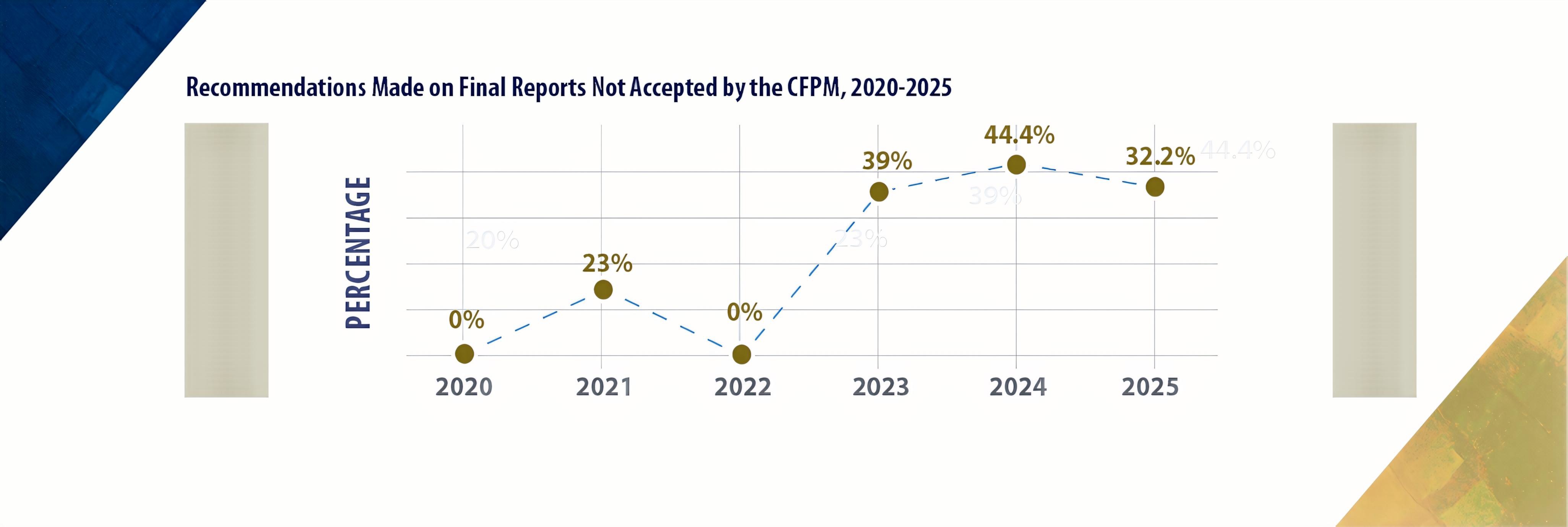
Alternate format
- 2020: 0%
- 2021: 23%
- 2022: 0%
- 2023: 39%
- 2024: 44.4%
- 2025: 32.2%
In 2025, the MPCC made 59 recommendations to improve military policing, covering areas such as racial profiling, sufficiency of investigations, transparency, documentation, major case management, evidence collection, policy, training, mentorship and supervision. This represents the highest number of recommendations made in a single year in the past decade.
| Safeguard Against Discrimination and Racial Profiling in Policing | ||
|---|---|---|
|
The MPCC recommends that the CFPM adopt either military police orders or policy instruments to aid military police members in preventing racial profiling and other forms of discriminatory treatment. |
MPCC-2021-010 |
Not Accepted |
|
The MPCC recommends as best practice that the CFPM interview complainants as well as subjects and witnesses in their investigations. This is particularly so where a complaint involves an allegation of discrimination and/or racial profiling. |
MPCC-2021-010 |
Not Accepted |
|
The MPCC recommends that the CFPM provide the office of Professional Standards investigators with training on the investigation and evaluation of complaints of racial profiling and discrimination. |
MPCC-2021-010 |
Not Accepted |
|
The complainant was handcuffed and put into an interview room under military police escort in error and based at least in part on discrimination. While the MPCC notes that military police sought to explain the error to the complainant, there is no evidence that military police took significant action to meet the complainant’s concerns or to offer an apology. The MPCC recommends that the CFPM issue a formal apology. |
MPCC-2021-010 |
Accepted |
| Improving Investigative Transparency and Documentation Standards in Military Police Investigations | ||
|---|---|---|
|
The MPCC recommends that the CFPM formally instruct all military police investigators, and in particular the subject members, that:
|
MPCC-2023-006 |
Partially |
|
The MPCC recommends that the CFPM take further measures to ensure that military police members consistently document all important exercises of discretion in investigation files, including reasons for not interviewing a potential witness, and to ensure this documentation is subject to supervisory review. |
MPCC-2023-006 |
Partially |
|
The MPCC recommends that the CFPM require military police investigators to prepare comprehensive, accurate and detailed summaries and/or transcripts of interviews. These records must clearly identify key facts, potential witnesses and investigative leads and be properly documented and annotated in the investigation file. This practice must be enforced as a standard of investigative accountability and subject to regular supervisory review. |
MPCC-2023-006 |
Partially |
|
The MPCC recommends that the CFPM implement further measures to ensure that supervisors at all levels consistently document their observations and direction in the Security and Military Police Information System under the title “Supervisory Comments” in each investigation file. These entries must include clear, specific, and actionable guidance provided to investigators, in accordance with Canadian Forces Military Police Order entitled “Investigation Management”, to reinforce accountability, ensure meaningful oversight, and uphold the integrity of the investigative process. |
MPCC-2023-006 |
Partially |
|
The MPCC recommends that the CFPM establish clear investigative protocols to guide CFNIS members in how to document, raise, and assess inconsistencies in complainant statements. These protocols should help ensure that discrepancies are fairly considered and appropriately addressed before referring cases to prosecutors. All such assessments should be documented in the investigative file to support transparency and oversight. |
MPCC-2023-006 |
Not Accepted |
|
The MPCC recommends that the CFPM direct all military police members to identify and document in the investigative file any discrepancies in statements that may identify new investigative avenues. Supervisory direction or decisions related to these discrepancies must also be clearly documented to support accountability and oversight. |
MPCC-2023-006 |
Partially |
|
The MPCC recommends that the CFPM reminds all military police members, but in particular the subject, of the importance of documenting every contact in an open investigation, including communication to relevant parties that the matter has been completed or closed, and documenting that they understand this. |
MPCC-2023-030 |
Accepted |
|
The MPCC recommends that the CFPM remind the subject of the best practices and the requirements for documenting investigative and/or administrative activities, as well as any other information or opinions relevant to the investigation in the police investigative file and his police notebook, in accordance with the relevant Canadian Forces Military Police Orders. |
MPCC-2023-030 |
Accepted |
|
The MPCC recommends that the CFPM ensures that the subject properly documents his actions and interactions as required by military policy. In particular, the MPCC recommends that the subject be asked to review Canadian Forces Military Police Order entitled “Dispatchers” as a shift supervisor (shift IC), as well as Canadian Forces Military Police Orders entitled “General Occurrence Reports” and “Street Checks.” |
MPCC-2023-019 |
Partially |
|
The MPCC recommends that the CFPM correct the record to reflect that a certain military police member adequately documented his interactions with the complainant in the file and that the failure to record the outcome rested with the subject who, as the responding member and shift supervisor (shift IC), did not document his interaction with the complainant. |
MPCC-2023-019 |
Accepted |
|
The MPCC recommends that the subject military police member exercise greater caution in the terms used to document police action, ensuring accuracy and adherence to professional standards. |
MPCC-2023-061 |
Accepted |
|
The MPCC recommends that the subject military police member be reminded of the importance of using the Mobile Video Recording System to record all incidents where military police exercise their policing duties and functions, ensuring an accurate and comprehensive record of events. |
MPCC-2023-061 |
Accepted |
|
The MPCC recommends that the CFPM ensures that the military police members involved follow up on any assistance request submitted to the CFNIS and document the outcome or note on the file their reasons for not doing so. |
MPCC-2019-037 |
Accepted |
|
The MPCC recommends that the CFPM issue specific guidance to supervisors for response to police error or misconduct. This ought to include the need for immediate review of incidents of police error or misconduct, the specific role that supervisors play in de-escalation of such incidents with a professional and rights conscious approach and debrief practices to prevent recurrence. |
MPCC-2021-010 |
Not Accepted |
| Complainant Notification and Transparency in Investigation Closure | ||
|---|---|---|
|
The MPCC recommends that the CFPM amend the Canadian Forces Military Police Order entitled “Military Police Investigation Policy” to ensure that all complainants are notified about the closure of the investigation. It is also recommended that the notification include a general summary of the investigation results, although certain details may need to be withheld due to privacy concerns. If a decision is made not to notify a complainant about the closure of an investigation, the reasons for this decision should be documented in the file. |
MPCC-2023-014 |
Accepted |
| Major Case Management Investigative Capacity, Training and Mentorship | ||
|---|---|---|
|
The MPCC recommends that the CFPM develop and implement a formal policy that clearly defines the situations and offences requiring major case management. This policy must ensure that all military police members receive continuous training on major case management throughout their careers. |
MPCC-2023-006 |
Not Accepted |
|
The MPCC recommends that the CFPM develop and implement a structured mentorship and leadership development program for military police investigators, with particular emphasis on complex and sensitive investigations. While the current practice of seconding experienced police officers from civilian enforcement agencies offers valuable support, this program should formalize and expand mentorship opportunities, drawing from both seconded civilian police officers and experienced members of the military police. The program should include clear selection criteria for mentors, formalized roles and expectations, and mechanisms to ensure continuity across postings. It should be supported by written policy and monitored for its impact on investigative quality, consistency, and institutional knowledge transfer. |
MPCC-2023-006 |
Partially |
| Strengthening Professional, Fair, and Competent Military Police Investigations Through Modernized Training | ||
|---|---|---|
|
The MPCC recommends that the CFPM implement mandatory and ongoing trauma-informed investigative training for all CFNIS members conducting investigations where complainants may have experienced trauma. This training should include guidance on the effects of trauma on memory, the distinction between credibility and reliability, and how to address inconsistencies during interviews in a manner that is both fair and evidence-based. |
MPCC-2023-006 |
Partially |
|
The MPCC recommends that the CFPM implement targeted training for all military police members on unconscious bias, cognitive bias, and tunnel vision, with particular attention to reinforcing investigative objectivity and critical thinking during decision-making. The military police subjects should be required to participate in such training. The training should equip members to detect, critically assess, and mitigate the effects of these biases throughout the investigative process, in order to uphold impartiality, preserve investigative integrity, and align with professional policing standards. |
MPCC-2023-006 |
Partially |
|
The MPCC recommends that the CFPM provide the subject members with refresher training in witness interviews and interviewing techniques. |
MPCC-2023-006 |
Accepted |
|
The MPCC recommends that the subject be provided training on strategies to combat racial profiling, including but not limited to unconscious bias and antiracism. |
MPCC-2021-010 |
Partially |
|
The MPCC recommends that the CFPM provide regular, ongoing training on cultural competency, unconscious bias and anti-racism to all military police members. |
MPCC-2021-010 |
Accepted |
|
The MPCC recommends that the CFPM ensure military police and civilians conducting and evaluating Canadian Police Information Centre (CPIC) queries, including the subject, be provided training or refresher training on proper procedures for CPIC usage, including verification procedures and index scoring. This may include but is not limited to Canadian Forces Military Police Orders “CPIC Query Procedures” and “CPIC Hit Confirmations,” as well as CPIC User Manual. |
MPCC-2021-010 |
Partially |
|
The MPCC recommends that the subject be provided training on investigative detentions, including the requirement to consider less intrusive measures and the totality of the circumstances. This may include but is not limited to the Canadian Forces Military Police Order “Investigative Detention” and the Canadian Forces Military Police Order “Use of Force – Restraint Application.” |
MPCC-2021-010 |
Partially |
|
The MPCC recommends that the CFPM provide updated and ongoing training to all military police members on investigative detention and use of force, with an emphasis on contextual analysis and proportionality. We note specifically that cautions in Canadian Police Information Centre must be assessed in context and not treated as predetermined requirements. |
MPCC-2021-010 |
Accepted |
|
The MPCC recommends that the CFPM update training programs at the Military Police Academy to ensure that the Charter and its application to investigative detention are properly covered. |
MPCC-2021-010 |
Not Accepted |
|
The MPCC recommends that the subjects be provided with training on their obligations with respect to note-taking procedures pursuant to the Canadian Forces Military Police Order entitled “Note-taking Procedures.” |
MPCC-2021-010 |
Not Accepted |
|
The MPCC recommends that the subjects be provided training in de-escalation measures and conflict management skills. |
MPCC-2021-010 |
Not Accepted |
|
The MPCC recommends that the CFPM ensure that all members of the Military Police receive training on communicating clearly with complainants regarding the status of investigations. |
MPCC-2023-030 |
Partially |
|
The MPCC recommends that the CFPM provide updated training to all military police members on the provision of victim services in high-risk situations, the exercise of discretion in identifying individuals at risk of family or intimate partner violence, and the procedures and legal authorities related to property removal following the breakdown of domestic relationships. |
MPCC-2023-019 |
Not Accepted |
| Improving Evidence Collection, Preservation and Retention in Military Police Investigations | ||
|---|---|---|
|
The MPCC recommends that the CFPM remind CFNIS investigators, and in particular the subject members, that they are required to obtain all potentially probative evidence, including contemporaneous notes from complainants and witnesses, at the earliest possible stage of an investigation. |
MPCC-2023-006 |
Accepted |
|
The MPCC recommends that the CFPM ensure all military police members, and in particular the subject members, be reminded of their duties of evidence preservation. |
MPCC-2021-010 |
Accepted |
|
The MPCC recommends that the CFPM review policies and procedures related to the securing and retention of video recordings (e.g., closed-circuit television (CCTV)) when detention or potential misconduct is alleged. |
MPCC-2021-010 |
Partially |
| Improving the Management and Protection of Police Notes | ||
|---|---|---|
|
The MPCC recommends that the CFPM ensure that their policy regarding “police notes” be updated to ensure that police notebooks are safeguarded when military police members retire from the Canadian Forces. |
MPCC-2023-006 |
Not Accepted |
|
The MPCC recommends that the subject be required to review Canadian Forces Military Police Order entitled “Police Notes.” |
MPCC-2021-010 |
Not Accepted |
| Ensuring Policy Compliance and Quality Assurance | ||
|---|---|---|
|
The MPCC recommends that the subject military police member be reminded of the limits of inventory searches to ensure compliance with legal and procedural guidelines. |
MPCC-2023-061 |
Accepted |
|
The MPCC recommends that the subject military police member carefully review Canadian Forces Military Police Orders entitled “Mobile Video Recording System” and “Searches and Seizures” to reinforce his understanding of the applicable procedures and guidelines. |
MPCC-2023-061 |
Accepted |
|
The MPCC recommends that the CFPM reminds all military police members, but in particular the subject member, of their obligation to ensure that all investigation related emails in their possession are promptly scanned and entered into the relevant investigation file in the Security and Military Police Information System. |
MPCC-2023-006 |
Partially |
|
The MPCC recommends that the CFPM reminds all military police members, but in particular the subject, of their obligation to document all investigative steps and to ensure that all investigation related emails in their possession are promptly scanned and entered into the relevant investigation file in the Security and Military Police Information System. |
MPCC-2023-030 |
Accepted |
|
The MPCC recommends that the CFPM direct the subject members to review Canadian Forces Military Police Orders entitled “Drafting Case and Prosecution Summaries” and “Concluding Remarks” to reinforce their understanding of proper procedures for drafting case summaries and concluding remarks in the Security and Military Police Information System. |
MPCC-2023-006 |
Accepted |
|
The MPCC recommends that the CFPM amend Canadian Forces Military Police Orders entitled “Drafting Case and Prosecution Summaries” and “Concluding Remarks” to include a mandatory quality control check. This procedure must require the responsible supervisor to formally verify and electronically attest in Security and Military Police Information System that the designated lead investigator has personally drafted and finalized the case summary and concluding remarks. |
MPCC-2023-006 |
Partially |
|
The MPCC recommends that the CFPM direct a specific Military Police Detachment to review their responsibilities under the Canadian Forces Military Police Order entitled “Dispatchers” regarding the use of non-recorded lines for dispatch calls and implement changes in line with the policy. |
MPCC-2023-019 |
Not Accepted |
| Improving Efficiency and Accountability in the Professional Standards Complaint Process | ||
|---|---|---|
|
The MPCC recommends that the CFPM conduct a comprehensive review of both internal processes and resource allocation within the office of Professional Standards. This review should assess whether operational inefficiencies, staffing levels, or other resource constraints are contributing to delays in resolving conduct complaints. |
MPCC-2024-020A |
Not Accepted |
|
Based on the findings of the review, the CFPM should determine the most effective course of action, which may include optimizing existing resources, implementing process improvements, or securing additional personnel and funding to meet statutory obligations under Part IV of the National Defence Act. |
MPCC-2024-020A |
Not Accepted |
|
The MPCC recommends that the CFPM establish regular internal audits and reviews of the complaints management process by the office of Professional Standards. These reviews should identify systemic issues and result in corrective actions to enhance accountability, improve operational efficiency, and prevent future delays in complaint handling. |
MPCC-2024-020A |
Not Accepted |
| Updating Military Police Policies to Align with Current Legal Standards | ||
|---|---|---|
|
The MPCC recommends that Canadian Forces Military Police Order entitled “CPIC Hit Confirmations” regarding wait times be updated to better reflect the jurisprudence. |
MPCC-2021-010 |
Partially |
|
The MPCC recommends that Canadian Forces Military Police Order entitled “Investigative Detention” be updated to better reflect the jurisprudence. |
MPCC-2021-010 |
Partially |
|
The MPCC recommends that the CFPM undertake a complete and comprehensive review of the military police orders applicable to investigative detention to ensure they reflect current jurisprudence. In particular, Canadian Forces Military Police Order on “Investigative Detention” should be updated to ensure that the various forms of investigative detention are outlined and guidance is provided when the right to retain and instruct counsel and to be informed of this right is required upon detention. |
MPCC-2021-010 |
Partially |
|
The MPCC further recommends that while this review is ongoing, the CFPM issue an immediate communication with interim guidance on the issue. |
MPCC-2021-010 |
Accepted |
| Clarifying Policies and Procedure for Responding to Intimate Partner Violence and Supporting Victims | ||
|---|---|---|
|
The MPCC recommends that the CFPM clarify Canadian Forces Military Police Orders entitled “Military Police Victim Services Program – General Framework” and “Family Violence” regarding how victim services are to be provided in situations where it is necessary to prevent escalation of a dangerous situation and/or the commission of offences. |
MPCC-2023-019 |
Partially |
|
The MPCC recommends that the CFPM clarify how military police members can exercise their discretion to determine who is, or is at risk of becoming, a victim of family violence (including intimate partner violence). |
MPCC-2023-019 |
Partially |
|
The MPCC recommends that the CFPM adopt clear procedures for military police asked to assist with property removal following breakdown of a domestic relationship, including legal authorities and expected follow-up. |
MPCC-2023-019 |
Partially |
Access to Justice
As an oversight agency and an administrative tribunal, the MPCC is committed to strengthening access to justice for complainants, subject members, and witnesses engaged in the complaints process. Building on the training delivered over the past two years which focused on decision-writing and trauma-informed approaches, the MPCC continued to embed trauma‑informed principles and fairness throughout its work.
In 2025, we have prioritized improving our operational processes. For instance, the MPCC refined its internal procedures to ensure that reviews and investigations are completed more quickly and efficiently. Despite a continued increase in the number of complaints, the average time required to complete investigations has decreased. We also introduced a complainant survey to help enhance the complaint process and better serve future users. After consultations and to ensure procedural fairness, the MPCC has adopted a new practice of providing subjects of investigations a copy of the complaint instead of a summary of the allegations with appropriate redactions to protect non-relevant personal information.
The MPCC website has also been modernized to improve accessibility and to be more user friendly. A prominent complaint icon now allows complainants to quickly access the online complaint form. Finally, to further enhance transparency and public understanding of our decisions, the MPCC will start publishing select full decisions in non-public interest cases. This will complement our existing practice of posting case summaries for conduct review and interference cases, as well as full decisions of public interest cases.
Outreach & Engagement
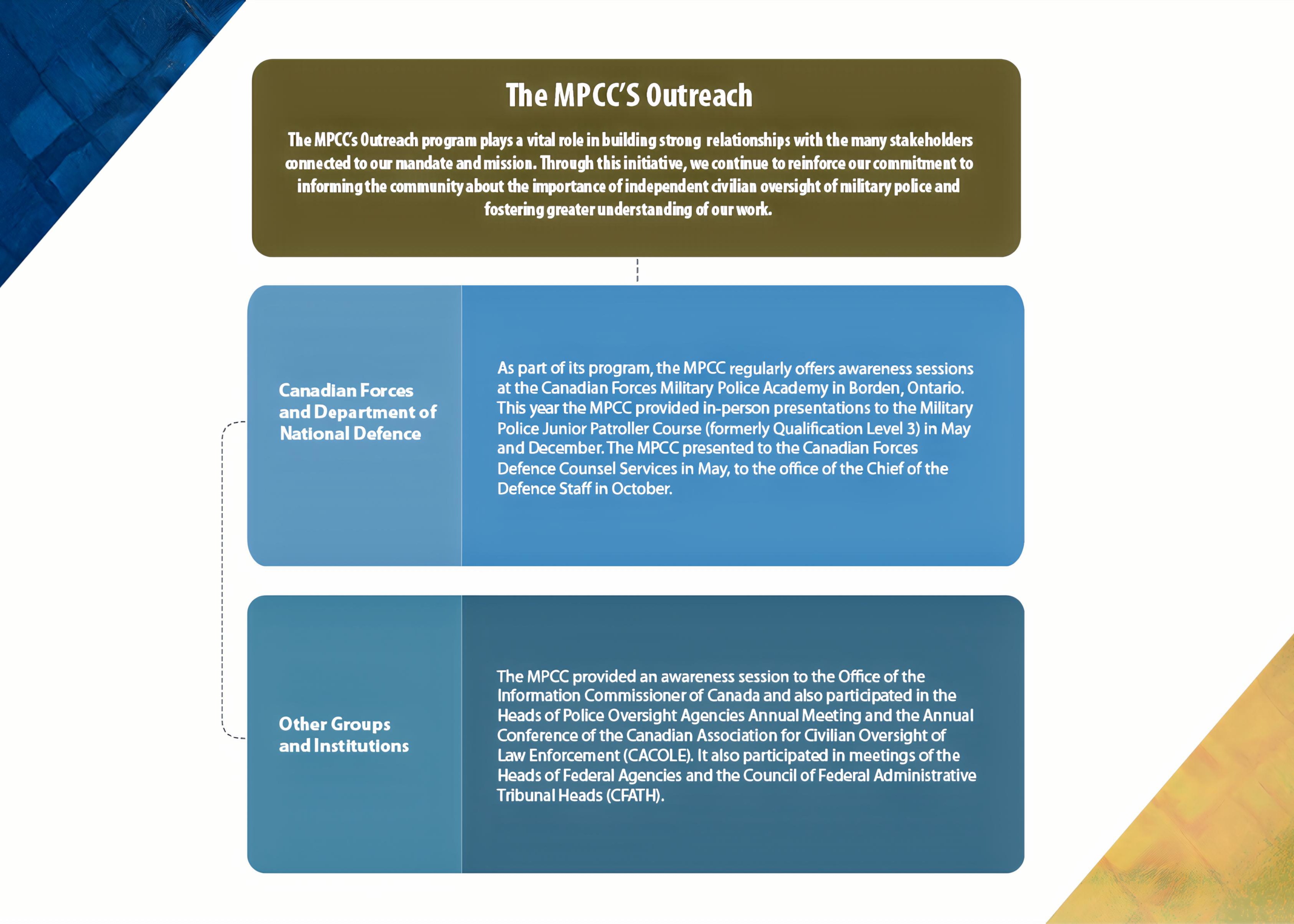
Alternate format
The MPCC’s Outreach: The MPCC’s Outreach program plays a vital role in building strong relationships with the many stakeholders connected to our mandate and mission. Through this initiative, we continue to reinforce our commitment to informing the community about the importance of independent civilian oversight of military police and fostering greater understanding of our work.
Canadian Forces and Department of National Defence
As part of its program, the MPCC regularly offers awareness sessions at the Canadian Forces Military Police Academy in Borden, Ontario. This year the MPCC provided in-person presentations to the Military Police Junior Patroller Course (formerly Qualification Level 3) in May and December. The MPCC presented to the Canadian Forces Defence Counsel Services in May, to the office of the Chief of the Defence Staff in October.
Other Groups and Institutions: The MPCC provided an awareness session to the Office of the Information Commissioner of Canada and also participated in the Heads of Police Oversight Agencies Annual Meeting and the Annual Conference of the Canadian Association for Civilian Oversight of Law Enforcement (CACOLE). It also participated in meetings of the Heads of Federal Agencies and the Council of Federal Administrative Tribunal Heads (CFATH).
Year in Review - Corporate Services
Financial Statement
Budget Constraint
The MPCC’s total actual expenditures for the 2024–2025 fiscal year ending March 31, 2025, was $5,776,668.
This amounted to an increase of over $142,000 compared to the previous fiscal year.
The table below shows the breakdown of budget allocations for fiscal year 2025-2026, using figures as of December 31, 2025.
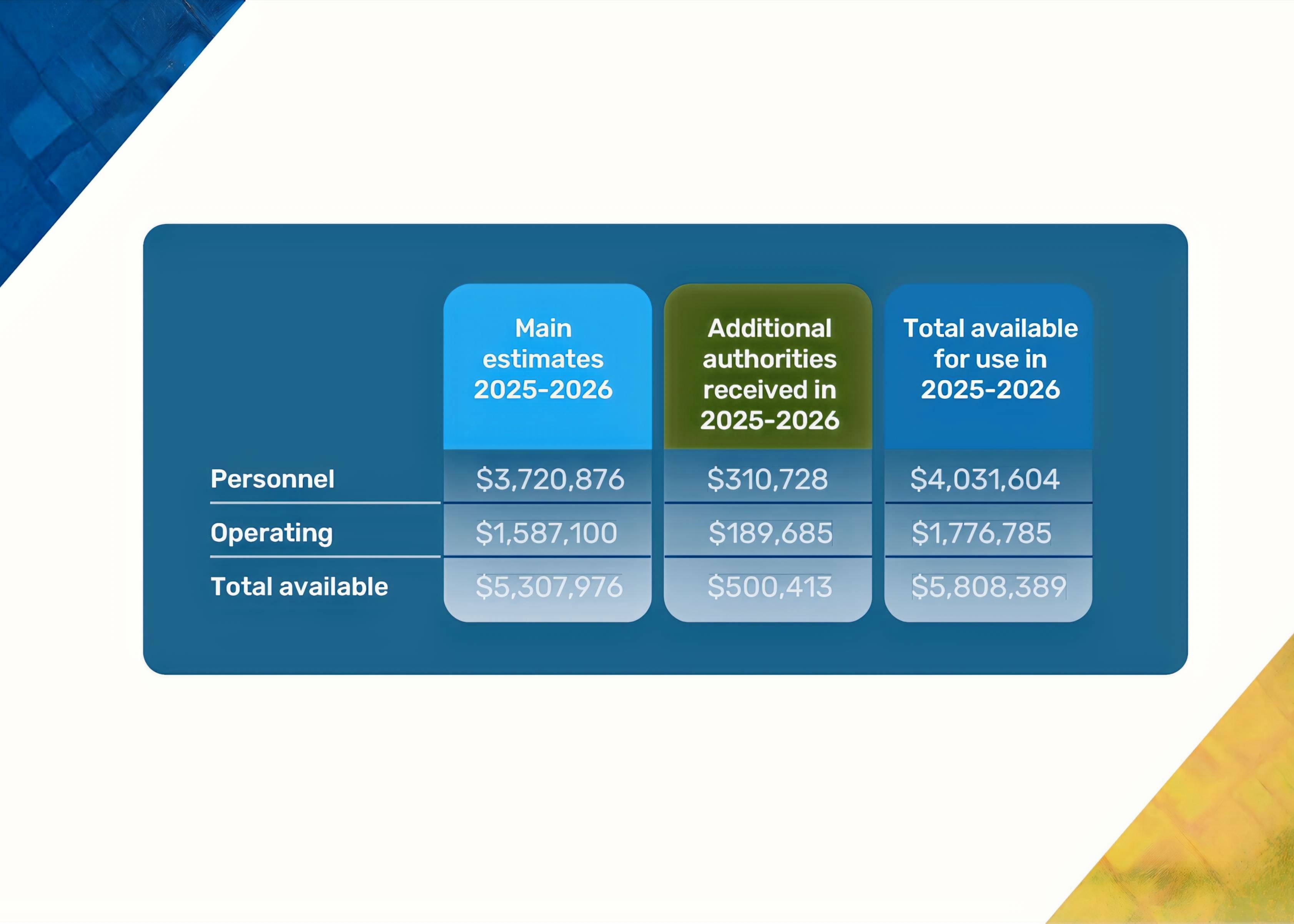
Alternate format
The image is that of a table showing, in dollars, the Military Police Complaints Commission of Canada’s budget allocations, divided into three columns with the following headings:
- Main estimates 2025-2026
- Additional authorities received in 2025-2026
- Total available for use in 2025-2026
The table is divided into 3 lines, as follows:
Line 1
Personnel
Main estimates 2025-2026 $3,720,876
Additional authorities received in 2025-2026 $310,728
Total available for use in 2025-2026
$4,031,604
Line 2
Operating
Main estimates 2025-2026 $1,587,100
Additional authorities received in 2025-2026 $189,685
Total available for use in 2025-2026
$1,776,785
Line 3
Total available
Main estimates 2025-2026 $5,307,976
Additional authorities received in 2025-2026 $500,413
Total available for use in
2025-2026 $5,808,389
In 2024-2025, the Department of National Defence agreed to a temporary transfer of $250K for both fiscal years 2024-2025 and 2025-2026 to help the MPCC manage the increase in the number and complexity of complaints. The MPCC was asked to monitor its caseload and its ability to deliver its mandate within its reference levels.
In early 2025, the MPCC requested that the temporary transfer be made permanent and increased to $500K so that the MPCC could benefit from an adequate financial framework to deal with the continuous increase in the number and complexity of complaint files and the costs of associated legal services. This request was approved by the Department of National Defence in July 2025. The MPCC received the additional $250K from the Department of National Defence in the fall of 2025.
As of December 31, 2025, the MPCC was forecasting an overall budget surplus of $137,000.
This amounts to 2.6% of our main estimates.
Diversity, Accessibility & Inclusion
The MPCC is committed to strengthening its internal processes, as it strives to become more inclusive and accessible to the benefit of those it serves. The MPCC remains steadfast in using an approach that is trauma-informed, incorporating intersectional principles, and viewing its work through an equity, diversity and inclusion lens.
This year, to improve accessibility, equity, diversity, and inclusion, the MPCC has:
- Continued to strive to provide an equitable, diverse and inclusive workplace. The MPCC is committed to offering accessible services to all users, complainants, and stakeholders. In 2025, the MPCC began asking complainants to complete a survey to enhance its processes and better serve future users and updated its website to ensure a more user-friendly platform.
- Published its third progress report on its multi-year accessibility plan, which includes improvements to the MPCC’s directives and workplace. Specifically in 2025, the digital Government of Canada Workplace Accessibility Passport was launched at the MPCC, and the service was introduced during an all-staff meeting. Also, an accessibility section was added to the organizational Information and Technology Asset Management Plan which includes a commitment from the MPCC’s Information Technology Division to make all their services, products and web content accessible to everyone.
- Continued to support the priorities of the Clerk of the Privy Council and other central agencies or government initiatives, including those dedicated to anti-racism, equity, diversity and inclusion in the federal public service. This support included adopting the Government of Canada Workplace Accessibility Passport which is a tool for public service employees to document support measures and tools they need to succeed in the workplace.
- Continued to refine and expand common objectives and performance indicators for all MPCC employees, ensuring these are reflected in their performance agreements and aligned with equity, diversity, and inclusion goals.
- Attracted and retained talented professionals who reflect the diversity of Canada. Notably, 27% of employees identify as members of a visible minority, and 14% as people with disabilities. The MPCC is also surpassing the aggregated workforce availability estimates for these employment equity groups, where members of visible minorities were represented at 22.7% and persons with disabilities were represented at 12%, according to the Employment Equity in the Public Service of Canada for Fiscal Year 2023 to 2024 report.
- Discussed and presented regular awareness sessions at staff meetings, focusing on accessibility, equity, diversity and inclusion. For example, a mandatory awareness session was given to all staff on fostering understanding between Indigenous and non-Indigenous perspectives, offering guidance on leadership, teamwork, and holistic approaches to community well-being.
Finally, the MPCC is proud to report that it largely exceeded its target for contracts with Indigenous companies. This year, 25.47% of the commission’s contracts were awarded to these companies, far exceeding the initial target of 5%.
Mental Health & Employee Well-Being
The MPCC has implemented several tangible actions and initiatives to promote a safe, positive and healthy workplace and to create a culture of inclusion and belonging:
- Participated in the 2024 Public Service Employee Survey: The MPCC is proud of the team’s strong participation and excellent results in the 2024 Public Service Employee Survey. In particular, the MPCC achieved outstanding scores in the areas of respect, diversity, and overall satisfaction. As the pace and demands of our work continue to grow, ensuring that employees feel seen, valued, and supported remains a top priority for the MPCC. The MPCC ranked No. 2 on the Best Public Service Workplaces 2025 list, as featured in an article published by the Ottawa Citizen on November 3, 2025. This recognition places the MPCC among the top workplaces in the federal government, out of 85 organizations evaluated.
- Reviewed and updated the MPCC’s Code of Conduct for Employees as well as the MPCC’s Code of Conduct for Commission Members in 2024 to reinforce ethical standards and ensure alignment with updated values and obligations of public service.
- Presented a session on Values and Ethics to employees in April 2024 by the MPCC’s mental wellness champion, the Senior General Counsel and Director General and the Manager of People Management.
- Inaugurated edition of the MPCC’s 2024-2025 Annual Report on Employee Misconduct and Wrongdoing marking another step in the MPCC’s commitment to ethical conduct, accountability, and transparency – embarking on a journey to renew the dialogue on how to bring our values and ethics to life in an increasingly complex and ever-changing world.
- Encouraged mental health and emotional well-being by offering a designated "Reflection Room" available to all employees at the office. It's a quiet space intended to support employee well-being; it serves as a safe, environment where employees can pause, recharge and reflect, during their day.
- Proactively shared and encouraged participation in mental health seminars and learning sessions to enhance understanding of mental health. In January 2025, an all-staff event was held to mark Bell Let’s Talk Day, facilitated by a certified life and professional development coach and speaker to discuss and present on stress management, dealing with high workload and how to destress. In May 2025, a mental wellness session was held for all staff on “Reframing negative or limiting thoughts/beliefs.”
- Continued to offer a variety of services to employees through an agreement with Health Canada. The Employee Assistance Services include Informal Conflict Management Services, an Ombudsperson Service, and an alternative external neutral third party for reporting violence or harassment. An information session to all staff was held in November 2025 on Informal Conflict Management Services and Ombuds services.
- Made mental wellness a frequent topic of discussion at all staff meetings throughout the year. The MPCC also promoted office cohesion by establishing monthly “lunch and learn” sessions, continuing virtual coffee breaks and “Good News Fridays” posts on the Microsoft Teams collaboration and communication platform.
Corporate Information
Organizational Profile
Appropriate Minister:
The Honourable David J. McGuinty, P.C., M.P., Minister of National Defence
Institutional Head:
Me Tammy Tremblay, MSM, CD, LL.M, Chairperson
Ministerial Portfolio:
Enabling Instrument:
Part IV of the National Defence Act
Year of Incorporation / Commencement:
1998
Other:
For more information, please visit the MPCC's website.
Organizational Contact Information
Information line
613-947-5625 or toll-free at 1-800-632-0566
Military Police Complaints Commission of Canada
270 Albert Street,
10th floor,
Ottawa, ON K1P 5G8
commission@mpcc-cppm.gc.ca
Note: We cannot guarantee the security of electronic communications. Therefore, please do not provide sensitive private information to us by email.
Website
Bluesky
Operating Context
Information on the operating context is available on the MPCC’s website.
- Date modified: