2024‑25 Departmental Results Report
____________________________
The Honourable David J. McGuinty, P.C., M.P.
Minister of National Defence
© His Majesty the King in Right of Canada, as represented by the Minister of National Defence 2025
Cat No. DP2‑7E‑PDF | ISSN 2560‑9157
Table of contents
At a Glance
This departmental results report details Military Police Complaints Commission of Canada’s (MPCC) actual accomplishments against the plans, priorities and expected results outlined in its 2024–25 Departmental Plan.
Key priorities
The MPCC identified the following key priorities for 2024-25:
- Strengthening the complaint process through adequate resourcing.
- Improving efficiencies through streamlined processes and improvements in the disclosure process.
- Innovation and Modernization of solutions to enhance the MPCC’s capacity to address complaints more efficiently, effectively and in a timely manner.
- Improving access to Justice by implementing more user-centric and trauma—informed approaches.
- Supporting our people to maintain a diverse, inclusive, bilingual and well-trained workplace.
- Advocate for Legislative Reform to modernize the MPCC mandate to be on par with other police oversight bodies in Canada.
Highlights for the Military Police Complaints Commission in 2024-25
- Total actual spending (including internal services): $5,776,668
- Total full-time equivalent staff (including internal services): 30 FTEs.
For complete information on the Military Police Complaints Commission’s total spending and human resources, read the Spending and human resources section of its full departmental results report.
Summary of results
The following provides a summary of the results the department achieved in 2024-25 under its main areas of activity, called “core responsibilities.”
Core responsibility 1: Independent Oversight of the Military Police
Actual spending: $3,449,928
Actual full-time equivalent staff: 14 FTEs
The MPCC’s results in 2024–25 reflect its commitments made in its 2024-25 Department Plan to: (1) strengthen the complaint process, (2) improve efficiencies, (3) innovation and modernization, (4) legislative reform, (5) access to justice, and (6) supporting our people. Our results were achieved through enhancing our review and investigation capacity, updating the intake procedures, exploring solutions to enhance the MPCC capacity to address complaints more efficiently and continuing to implement trauma- informed and user focused approaches. We also leverage technology to improve the timeliness and efficiency of our investigations.
Recognizing the importance of a diverse and representative team, we continued to focus on attracting and retaining talented professionals who reflect the diversity of Canada. Once again, this year, the MPCC is proud to report that no employment equity designated group is under-represented in its workforce. In fact, 27% of employees identify as members of a visible minority, and 14% as people with disabilities.
Almost all our targets were exceeded even if the MPCC has seen a significant rise in the number of new conduct complaints over the past few years, resulting in an increased workload.
The MPCC surpassed two of three performance targets: no final decisions were overturned by the Federal Court (no new challenges were issued during the reporting period), and all interim reports in non-public interest cases were issued within 18 months.
The one target it did not meet was related to the CFPM’s acceptance of only half of MPCC recommendations. Given that this indicator is misaligned with the objectives of the oversight regime (as the oversight body should not be at the mercy of the overseen for performance indicators) we have made representations to remove it as a performance measure in future reports.
In 2023-24, we advocated legislative reform by writing to the Minister of National Defence and providing a comprehensive matrix of proposals, incorporating recommendations from Justice Fish’s report, and discussed additional reform ideas. In 2024-25, we put pen to paper and drafted a proposed Bill to update the oversight and accountability regime of the military police, which was shared with the Minister of National Defence and stakeholders in December 2024.
For more information on Military Police Complaints Commission’s Independent Oversight of the Military Police read the “Results – what we achieved” section of its departmental results report.
From the Institutional Head

Me Tammy Tremblay,
Chairperson
I am pleased to present the Military Police Complaints Commission of Canada's (MPCC) 2024–25 Departmental Results Report highlighting our key accomplishments in delivery of independent civilian oversight of the military police.
The MPCC’s results this year reflect its commitment to the six priorities outlined in its 2024–25 Departmental Plan: (1) strengthening the complaint process, (2) improving operational efficiency, (3) fostering innovation and modernization, (4) advancing legislative reform, (5) promoting access to justice, and (6) supporting our people. These priorities were supported by a focus on transparency, public engagement, and timely, user-focused service delivery.
Despite managing a caseload marked by both volume and complexity, the MPCC exceeded nearly all its performance targets related to service, public access, and outreach. These results were achieved through targeted enhancements to our review and investigation capacity, revisions to intake procedures, the implementation of trauma-informed and user-centred approaches, and the deployment of new technology to improve timeliness and effectiveness.
The MPCC met or exceeded almost all performance targets on quality, transparency and timeliness. The only exception was related to the acceptance of our recommendations by the Canadian Forces Provost Marshal (CFPM). Given that this indicator is misaligned with the principles of independent civilian oversight, that the oversight body should not rely on the entity it monitors to define performance metrics—we have formally requested its removal as a performance measure in future reports.
The MPCC also prioritized building capacity through process improvements and staff training, particularly in trauma-informed and user-centred practices, to ensure people feel heard, respected and safe and to avoid risk of re-traumatization.
Recognizing that a diverse and representative workforce is essential to inclusive oversight, the MPCC continued to focus on attracting and retaining talent reflective of Canada’s diversity. For the second consecutive year, no employment equity group is under-represented at the MPCC. In 2024–25, 27% of employees identified as members of a visible minority and 14% as persons with disabilities.
These results are the product of dedicated efforts across the organization. I extend my sincere thanks to all MPCC employees for their professionalism, commitment, and excellence in upholding our mandate.
Sincerely,
Me Tammy Tremblay, MSM, CD, LL.M
Chairperson
Results – what we achieved
Core responsibilities and internal services
- Core responsibility 1: Independent Oversight of the Military Police
- Internal services
Core responsibility 1: Independent Oversight of the Military Police
In this section
Description
The Military Police Complaints Commission of Canada promotes and ensures the highest standards of conduct of military police in the performance of policing duties and discourages interference in any military police investigation through independent and impartial reviews, investigations and hearings which result in sound findings and recommendations.
Quality of life impacts
The MPCC’s core responsibility contributes to the “Good governance” domain of the Quality of Life Framework for Canada.
Good Governance: To have a well-functioning democracy, it is important that all individuals have their fundamental rights and freedoms respected, can participate in civil society, and know that their voices are being heard. Having public institutions that are trusted to function effectively and treat all people impartially is critical in ensuring that all people in Canada feel safe and have access to the public services they need.
The MPCC’s core responsibility contributes to “Good Governance / Democracy and Institutions” domain of the Quality-of-Life Framework for Canada, and more specifically, “Confidence in institutions,” through all the activities mentioned in the core responsibility description. As an administrative tribunal responsible for providing oversight of the military police, building confidence in the police through the complaints process is at the heart of the MPCC’s mandate.
The MPCC’s core responsibility further contributes to “Good Governance / Justice and Human Rights” domain of the Quality-of-Life Framework for Canada, and more specifically, “Discrimination and unfair treatment,” and “Access to fair and equal justice” through all the activities mentioned in the core responsibility description. The MPCC is an administrative tribunal whose goal is to provide fair and equal access to justice for the public. Complaints received by the MPCC about the military police may deal with subject matters such as discrimination and unfair treatment.
Progress on results
This section details the department’s performance against its targets for each departmental result under Core responsibility 1: Independent Oversight of the Military Police.
Table 1: Final Reports provide sound findings and recommendations and are issued in a timely manner.
Table 1 shows the target, the date to achieve the target and the actual result for each indicator under Final Reports provide sound findings and recommendations and are issued in a timely manner in the last three fiscal years.
| Departmental Result Indicator | Target | Date to achieve target | Actual Results |
|---|---|---|---|
| Percentage of recommendations resulting from investigations of conduct or interference complaints are accepted by the responsible Department of National Defence authority (usually the Canadian Forces Provost Marshal). | 70% | March 31, 2024 | 2022–23: 93.75% 2023–24: 30% 2024–25: 50% |
| Percentage of Final Decisions not overturned on Judicial Review. | 70% | March 31, 2024 | 2022–23: 100% 2023–24: 100% 2024–25: 100% |
| Percentage of interim reports issued in non-public interest cases within 18 months from the time disclosure is substantially received, excluding periods where the file is put in abeyance. It is recognized that there may be exceptionally complex cases which will not meet this indicator. | 70% | March 31, 2024 | 2022–23: 50% 2023–24: 70% 2024–25: 100% |
Table 2: Information requests pertaining to complaint files are responded to in a timely manner
Table 2 shows the target, the date to achieve the target and actual result for each indicator under Information requests pertaining to complaint files are responded to in a timely manner in the last three fiscal years.
| Departmental Result Indicator | Target | Date to achieve target | Actual Results |
|---|---|---|---|
| Percentage of information requests initially responded to within 48 hours. | 95% | March 31, 2024 | 2022–23: 97.22% 2023–24: 96.19% 2024–25: 98.28% |
Table 3: Military Police and the public have access to current information on the issues addressed by the MPCC.
Table 3 shows the target, the date to achieve the target and the actual result for each indicator under Military Police and the public have access to current information on the issues addressed by the MPCC in the last three fiscal years.
| Departmental Result Indicator | Target | Date to achieve target | Actual Results |
|---|---|---|---|
| Quarterly website updates of MPCC findings and recommendations through case summaries and MPCC Final Reports in public interest cases. | 4 | March 31, 2024 | 2022–23: 7 2023–24: 10 2024–25: 10 |
| Number of Outreach activities/presentations given on the mandate, roles and responsibilities of the MPCC. | 6 | March 31, 2024 | 2022–23: 25 2023–24: 11 2024–25: 9 |
| Percentage of presentations to stakeholder or target groups that were received positively. | 70% | March 31, 2024 | 2022–23: 76% 2023–24: 80% 2024–25: 100% |
The Results section of the Infographic for the Military Police Complaints Commission on GC Infobase page provides additional information on results and performance related to its program inventory.
Details on results
The following section describes the results for Independent Oversight of the Military Police in 2024–25 compared with the planned results set out in Military Police Complaints Commission’s departmental plan for the year.
Final Reports provide sound findings and recommendations and are issued in a timely manner.
Results achieved
The MPCC issued 8 Final Reports and exceeded two of three indicators: no decisions were overturned by the Federal Court, and all Interim Reports in non-public interest cases were issued on time.
Both volume and complexity of the workload were high with six Public Interest Investigations and 18 extensions of time applications. Moreover, continued challenges in obtaining timely and complete disclosure from the CFPM’s office added to that workload.
- Percentage of recommendations resulting from investigations of conduct or interference complaints are accepted by the responsible Department of National Defence authority (usually the CFPM).
- Only 50% of the MPCC’s 8 recommendations were accepted. Issues raised included note-taking, welfare checks, retention of evidence, and conflict of interest. Given this indicator does not appropriately measure the target, nor is it within the control of the MPCC, it will be removed in future reporting cycles.
- Percentage of Final Decisions not overturned on Judicial Review:
- MPCC exceeded its target with no final decisions overturned by the Federal Court.
- Percentage of Interim Reports (including Concluding Reports) issued in non-public interest cases within 18 months from the time disclosure is substantially received, to the issuance of the Interim Report.
- The MPCC met 100% of its target, issuing Interim Reports within 18 months - surpassing the 70% goal. Improvements included streamlined investigations, updated intake procedures, plain language decision writing, trauma-informed training, and better use of technology.
- Despite these achievements, the MPCC continued to face challenges including the continuing high volume and complexity of complaints. Moreover, restrictive interpretations of the National Defence Act by the CFPM posed barriers to the efficient and effective discharge of the MPCC mandate in some instances.
- To resolve these challenges the MPCC proposed legislative reform of the oversight of the military police, including by drafting and submitting a proposed bill to enhance independent civilian oversight of the military police.
Information requests pertaining to complaint files are responded to in a timely manner
Results achieved
The MPCC exceeded its target result by responding to 98% of information requests within 48 hours.
- This result reflects ongoing efforts to improve efficiency and provide responsive, user-focused service. MPCC staff received training in trauma-informed practices to reduce the risk of re-traumatization, ensure engagements with the users of the complaint process who feel heard, safe and respected. This training also helps our staff recognize signs of trauma in others, vicarious trauma and manage their own stress response.
Military Police and the public have access to current information on the issues addressed by the MPCC
Results achieved
The MPCC achieved its target results for this indicator.
- Quarterly website updates of MPCC findings and recommendations through case summaries and Final Reports in public interest cases:
- The MPCC exceeded its target and posted 10 web summaries on time. Improvements included clearer, plain-language content and a new search tool to enhance access to past decisions and case summaries.
- Number of outreach activities and presentations on the MPCC’s mandate, roles, and responsibilities:
- The MPCC econducted nine outreach activities over the fiscal year exceeding its target. Audiences included the Canadian Police College, the Office of the Federal Ombudsperson for Victims of Crime, Ukrainian Parliamentarians exploring oversight models, and the Union of National Defence Employees. The MPCC also continued its engagement with the Canadian Forces Military Police Academy and the Canadian Forces Chain of Command. In addition, the MPCC actively participated in the Heads of Police Oversight Agencies Annual Meeting and the Annual Conference of the Canadian Association for Civilian Oversight of Law Enforcement (CACOLE).
- Percentage of presentations to stakeholder or target groups that were received positively:
- The MPCC surpassed its target, with 80% of participants rating the sessions favourably. Input from 226 attendees helped refine future presentations.
Key Risks
Resource Sustainability
Financial Management: In 2024–25, the MPCC requested a permanent $500,000 budget transfer from the Department of National Defence (DND) to help address the increasing volume and complexity of complaints, as well as the ongoing rise in fixed operating costs. DND approved a permanent transfer of $250,000, with an additional $250,000 allocated on a temporary basis for fiscal years 2024–25 and 2025–26. The MPCC will continue to closely monitor its caseload and operational capacity to ensure it can meet its mandate effectively.
Human Resources Management: Given the MPCC’s small size, employees are often required to assume multiple responsibilities. Retaining experienced and skilled staff remains a key challenge, particularly in a micro-organization with limited opportunities for advancement. Delays in filling vacancies further compound these pressures making workforce planning is a critical priority.
To address these challenges, the MPCC is committed to building a strong, diverse, and resilient workforce. This includes enhancing human resources planning, implementing proactive staffing and talent management strategies, and promoting flexible work arrangements to support employee retention and engagement.
Timeliness of the Complaints Process and Investigations
The MPCC faced significant barriers from the CFPM’s office including refusal to disclose relevant information necessary to advance investigations as required by the National Defence Act and narrow interpretations of the MPCC mandate.
To uphold its mandate, the MPCC was compelled to initiate costly procedures before the Federal Court to obtain the documents it requested and is legally entitled to review to carry out investigations. The MPCC could have litigated many more files but only chose to litigate a few given the cost of these challenges.
If challenges persist, they will undermine the MPCC’s ability to meet service standards or carry out its legislative responsibilities. An additional concern is the escalating financial burden on the MPCC if it must continue resorting to the courts to access the information necessary for its investigations.
Weakened Oversight
The primary challenge this year was the continued erosion of the MPCC’s ability to effectively oversee the military police. No significant legislative reforms have been made since 1999. Legislative reform is needed to strengthen the MPCC’s mandate and grant it improved access to information necessary to investigate complaints. In 2024, the MPCC submitted a draft legislative proposal to the Minister of National Defence. These reforms are vital to restoring effective civilian oversight and public trust in military policing.
Resources required to achieve results
Table 4: Snapshot of resources required for Independent Oversight of the Military Police
Table 4 provides a summary of the planned and actual spending and full-time equivalents required to achieve results.
| Resource | Planned | Actual |
|---|---|---|
| Spending | 3,407,234 | 3,449,928 |
| Full-time equivalents | 16 | 14 |
The Finances section of the Infographic for the Military Police Complaints Commission on GC Infobase page and the People section of the Infographic for the Military Police Complaints Commission on GC Infobase page provide complete financial and human resources information related to its program inventory.
Related government-wide priorities
This section highlights government priorities that are being addressed through this core responsibility.
Gender-Based Analysis Plus
A key MPCC objective under its GBA+ Strategy is to ensure equitable and inclusive access to justice. GBA+ considerations are integrated in all aspects of our operations, ensuring that policies, procedures and interactions with the users of the complaints process are barrier-free, responsive to diverse needs and lived experience.
We also engaged with peer oversight organizations to learn about their approaches to demographic data collection in the context of GBA+. As a result of these discussions and our own research, we developed a voluntary and anonymous demographics form for complainants, which will be implemented once final privacy protocols are in place.
United Nations 2030 Agenda for Sustainable Development and the Sustainable Development Goals
While the MPCC does not report directly on the United Nations’ Sustainable Development Goals, the organization supported the 2022 to 2026 Federal Sustainable Development Strategy. The MPCC also recognizes that all organizations have Greening Government obligations and have a role to play in supporting implementation of the United Nations Declaration on the Rights of Indigenous Peoples Act.
The MPCC continued to support the transition to a low-carbon economy through green procurement in support of the Support for United Nations Sustainable Development Goal 12.7 – Ensure sustainable consumption by:
- Ensuring decision-makers have the necessary training and awareness to support green procurement;
- Reducing travel by attending conferences and conducting meetings virtually;
- Ensuring training is provided to all acquisition cardholders on green procurement;
- Ensuring Contracting Officer participated in the Procurement in the Nunavut Settlement Area training session through the Canada School of the Public Service; and
- Awarding 25.47% of monetary contracts to businesses managed and led by Indigenous Peoples
More information on the Military Police Complaints Commission’s contributions to Canada’s Federal Implementation Plan on the 2030 Agenda and the Federal Sustainable Development Strategy can be found in our Departmental Sustainable Development Strategy.
Innovation
During the 2024–25 fiscal year, the MPCC undertook several innovative initiatives to strengthen its ability to fulfill its core responsibility—independent civilian oversight of the military police. These efforts focused on enhancing service accessibility, operational efficiency, and technological capacity:
- Case Management System Evaluation: The MPCC launched a comprehensive evaluation to assess the adoption of a dedicated case management system for its operations. Through consultations with similar oversight and tribunal organizations, the MPCC reviewed a variety of systems to determine their effectiveness and suitability. This evaluation remains ongoing and is expected to support more structured and efficient case tracking and reporting in the future. Additionally, a business analysis was conducted to identify the most efficient case management system for our organization. A new system will be implemented next year.
- Exploration of Artificial Intelligence Tools and Awareness to Staff: The MPCC has advanced the use of AI by researching its potential role in enhancing its administrative function. Through consultations with other administrative tribunals and organizations, the MPCC gained insights into emerging AI tools and governance guidelines. This exploratory work positions the MPCC to evaluate the responsible use of AI, ensuring adherence to principles of fairness, accountability, and transparency.
Program inventory
The independent oversight of the military police is supported by the following programs:
- Complaints Resolution
Additional information related to the program inventory for Independent Oversight of the Military Police is available on the Results page on GC InfoBase.
Internal services
In this section
Description
Internal services refer to the activities and resources that support a department in its work to meet its corporate obligations and deliver its programs. The 10 categories of internal services are:
- Management and Oversight Services
- Communications Services
- Legal Services
- Human Resources Management
- Financial Management
- Information Management
- Information Technology
- Real Property
- Materiel
- Acquisitions
Progress on results
This section presents details on how the department performed to achieve results and meet targets for internal services.
- Diversity, Equity, and Inclusion: The MPCC successfully recruited, retained, and promoted employees from various employment equity groups, ensuring no under-representation of designated groups under the Employment Equity Act. As of March 31st, 27% of employees self-identified as visible minorities and 14% as persons with disabilities – exceeding labour market availability benchmarks.
- Additionally, the MPCC contributed to the government Accessibility Strategy for the Public Service of Canada by hiring an employee with a disability and an employee from the Black community through a development opportunity that supports the government's Black Public Servants Action Plan. These hires have contributed valuable perspectives and experience, enhancing the organization’s effectiveness and inclusivity.
- In addition, the MPCC held various all staff events and facilitated discussions on topics related to anti-racism and Reconciliation.
- Workplace Safety and Health: The MPCC continued to cultivate a safe, positive, and healthy workplace free from harassment or threatening behaviors. The external harassment policy, first implemented in 2022, remained a focus and was regularly promoted. Harassment and violence prevention featured as a standing item at all-staff meetings. Senior leadership reinforced the importance of this commitment through educational videos and presentations. Notably, no harassment and violence complaints were reported to the Senior Management team or the Health and Safety Committee.
- Accessibility: In December 2024, the MPCC published its second Accessibility Plan – Progress Report, demonstrating its ongoing efforts to foster an inclusive and accessible workplace. The report highlighted progress made over the past year, which includes significant workspace improvements for accessibility, surpassing employment targets for people with disabilities, and maintaining flexible communication methods. The MPCC remains committed to further enhancing inclusivity and accessibility, guided by trauma-informed and equity-focused principles, and welcomes feedback to continue meeting the goals of the Accessible Canada Act.
- Values and Ethics: The MPCC supported the Clerk’s priorities and government-wide initiatives on values and ethics by reviewing and updating both its employee Code of Conduct and Members Code of Conduct. All staff and members are required to annually confirm their understanding and adherence to these codes. Performance objectives related to integrity, respect, and diversity were incorporated into all employees and management performance agreements. Employees are encouraged to make transparent decisions, uphold ethical standards, and engage in conversations about openness, inclusiveness, and ethics. On April 24th, the Senior General Counsel and Director General as the Values and Ethics Champion together with the HR Advisor hosted a facilitated discussion on values and ethics in the workplace and the Public Service as a whole. The MPCC also maintained a strong commitment to the Official Languages Act, ensuring that all communications and interactions uphold language rights and obligations.
- Interdepartmental Collaboration and efficiencies: Internal services employees actively participated in interdepartmental government meetings, maintaining networks and collaborative relationships with government functional communities and peers. The collaborations ensured MPCC staff were informed about trends and innovations. Efforts in process optimization led to efficiencies in the corporate services sector and enabled the IT group to implement a new virtualization solution enhancing digital infrastructure and service delivery.
- Control Management: The MPCC's multi-year Internal Control Monitoring Plan was advanced through audits conducted by an external firm on payroll administration, budgeting and forecasting, IT asset planning, and the annual reporting processes. There were no new recommendations that came from the latest audit. To further advance operational efficiency, updates to the financial delegation matrix and human resources delegation instrument were developed to decentralize certain authorities. These updates helped streamline internal processes, including a revised internal directive on ergonomic assessments and equipment provisions for remote work. A new procurement management framework is scheduled to be presented to the Executive Committee at the start of the 2025-26 fiscal year.
Resources required to achieve results
Table 5: Resources required to achieve results for internal services this year
Table 5 provides a summary of the planned and actual spending and full-time equivalents required to achieve results.
| Resource | Planned | Actual |
|---|---|---|
| Spending | 2,277,453 | 2,326,740 |
| Full-time equivalents | 15 | 16 |
The Finances section of the Infographic for Military Police Complaints Commission on GC Infobase and the People section of the Infographic for Military Police Complaints Commission on GC Infobase provide complete financial and human resources information related to its program inventory.
Contracts awarded to Indigenous businesses
Government of Canada departments and agencies are to meet a target of awarding at least 5% of the total value of contracts to Indigenous businesses each year.
Military Police Complaints Commission results for 2024-25:
Table 6 Total value of contracts awarded to Indigenous businesses
As shown in Table 6, the Military Police Complaints Commission awarded 25.47 % of the total value of all contracts to Indigenous businesses for the fiscal year.
| Contracting performance indicators | 2024-25 Results |
|---|---|
| Total value of contracts awarded to Indigenous businessesFootnote 1(A) | 75,582.18 |
| Total value of contracts awarded to Indigenous and non‑Indigenous businessesFootnote 2 (B) | 564,665.60 |
| Value of exceptions approved by deputy head (C) | 267,956.90 |
| Proportion of contracts awarded to Indigenous businesses [A / (B−C) × 100] | 25.47 % |
Table 1 Notes
|
|
Spending and human resources
In this section
Spending
This section presents an overview of the department's actual and planned expenditures from 2022–23 to 2027–28.
Refocusing Government Spending
In Budget 2023, the government committed to reducing spending by $14.1 billion over five years, starting in 2023–24, and by $4.1 billion annually after that. While not officially part of this spending reduction exercise, to respect the spirit of this exercise, the MPCC undertook the following measures in 2024-25.
- Budget Planning
- We have maintained rigorous oversight of our financial resources through the preparation and presentation of monthly financial situation reports to the Executive Committee. These reports have supported effective and timely decisions, enabling the reallocation of resources to priority areas and the early identification of financial pressures and cost-saving opportunities.
- Resources Optimization
- We have enhanced operational efficiency by maximizing internal capacity and reducing reliance on external contactors. For instance, certain investigative functions previously outsourced have been reassigned to internal staff, resulting in measurable cost savings.
- Travel Costs Reduction
- We have significantly curtailed travel expenditures by prioritizing virtual participation in conferences and training sessions. Outreach activities have also been effectively delivered through virtual platforms, allowing us to maintain stakeholder engagement while minimizing operational costs.
- Leveraging Government Partnerships
- We continue to strengthen collaboration with federal service departments to drive efficiencies across key operational areas. Notably, partnership with shared service providers has streamlined processes in human resources and IT, reducing duplication and enhancing service delivery.
Budgetary performance summary
Table 7: Actual three-year spending on core responsibilities and internal services (dollars)
Table 7 shows the money that the Military Police Complaints Commission spent in each of the past three years on its core responsibilities and on internal services.
| Core responsibilities and internal services | 2024–25 Main Estimates | 2024–25 total authorities available for use | Actual spending over three years (authorities used) |
|---|---|---|---|
| Independent Oversight of the Military Police | 3,348,435 | 3,819,360 |
|
| Subtotal | 3,348,435 | 3,819,360 |
|
| Internal services | 2,238,254 | 2,349,096 |
|
| Total | 5,586,689 | 6,168,456 |
|
Analysis of the past three years of spending
The table above shows that the MPCC spent 90% of its available core responsibility authorities, along with 99% of its Internal Services authorities. This was only possible due to a permanent budget transfer of 250K from DND, and an additional 250K in temporary funds in 2024-25.
This increased spending is attributable to the continued increase in both the number and complexity of investigations conducted by the MPCC, including several Public Interest Investigations. Internal Services costs continued to increase, as the MPCC remains dependent on many service level agreements with other government departments and does not receive compensation allocations that accompany these cost increases.
The Finances section of the Infographic for the Military Police Complaints Commission on GC Infobase offers more financial information from previous years.
Table 8: Planned three-year spending on core responsibilities and internal services (dollars)
Table 8 shows the Military Police Complaints Commission’s planned spending for each of the next three years on its core responsibilities and on internal services.
| Core responsibilities and internal services | 2025–26 planned spending | 2026–27 planned spending | 2027–28 planned spending |
|---|---|---|---|
| Independent Oversight of the Military Police | 3,546,384 | 3,348,518 | 3,323,498 |
| Subtotal | 3,546,384 | 3,348,518 | 3,323,498 |
| Internal services | 2,298,963 | 2,232,346 | 2,215,666 |
| Total | 5,845,347 | 5,580,864 | 5,539,164 |
Analysis of the next three years of spending
The MPCC’s planned spending is higher for 2025-26, as it includes the last of a two-year $250K fund transfer from DND, which was required due to the rise in both the number and complexity of complaints in recent years.
Planned spending for the following two years is currently capped at our Main Estimates levels. However, the MPCC reached out to DND to request that the temporary transfer of 250K become permanent for 2026-27 and beyond. Funding for additional human resources was also sought to enable the MPCC to fulfill its mandate.
The Finances section of the Infographic for the Military Police Complaints Commission on GC Infobase offers more detailed financial information related to future years.
Funding
This section provides an overview of the department's voted and statutory funding for its core responsibilities and for internal services. Consult the Government of Canada budgets and expenditures for further information on funding authorities.
Graph 1: Approved funding (statutory and voted) over a six-year period
Graph 1 summarizes the department's approved voted and statutory funding from 2022-23 to 2027-28.
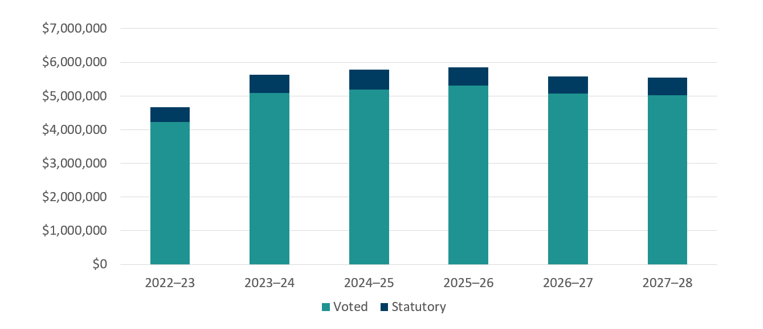
Approved funding (statutory and voted) over a six-year period
| Fiscal Year | Statutory | Voted | Total |
|---|---|---|---|
| 2022-23 | 434,668 | 4,223,825 | 4,658,493 |
| 2023-24 | 553,222 | 5,081,060 | 5,634,282 |
| 2024-25 | 592,599 | 5,184,069 | 5,776,668 |
| 2025-26 | 537,371 | 5,307,976 | 5,845,347 |
| 2026-27 | 517,477 | 5,063,387 | 5,580,864 |
| 2027-28 | 517,477 | 5,021,687 | 5,539,164 |
Analysis of statutory and voted funding over a six-year period
The graph above demonstrates the current trend of expenditure increases related to the rise in both the number and complexity of complaints in recent years. The temporary fund transfer of $250K from DND for both 2024-25 and 2025-26 is also seen in the graph above, with a return to normal Main Estimates levels in 2026-27 and beyond.
However, due to the significant increase in cases in recent years, maintaining the current level of financial resources is no longer feasible for the MPCC. Consequently, the organization has requested additional funding from the DND to expand its resources and ensure it can effectively fulfill its mandate.
Consult the Public Accounts of Canada for further information on the Military Police Complaints Commission’s departmental voted and statutory expenditures.
Financial statement highlights
The Military Police Complaints Commission’s Financial Statements (Unaudited) for the Year Ended March 31, 2025.
Table 9: Condensed Statement of Operations (unaudited) for the year ended March 31, 2025 (dollars)
Table 9 summarizes the expenses and revenues for 2024–25 which net to the cost of operations before government funding and transfers.
| Financial information | 2024–25 actual results | 2024–25 planned results | Difference (actual results minus planned) |
|---|---|---|---|
| Total expenses | 6,156,656 | 6,056,126 | 100,530 |
| Total revenues | 0 | 0 | 0 |
| Net cost of operations before government funding and transfers | 6,156,656 | 6,056,126 | 100,530 |
Analysis of expenses and revenues for 2024-25
The MPCC saw a very slight increase in its actual expenses compared to the planned amount for 2024-25. This increase was expected as overall expenditures continued to rise year after year, mainly due to the steady increase in both the number and complexity of complaint files.
The 2024–25 planned results information is provided in the Military Police Complaints Commission’s Future-Oriented Statement of Operations and Notes 2024–25.
Table 10: Condensed Statement of Operations (unaudited) for 2023-24 and 2024-25 (dollars)
Table 10 summarizes actual expenses and revenues and shows the net cost of operations before government funding and transfers.
| Financial information | 2024–25 actual results | 2023–24 actual results | Difference (2024-25 minus 2023-24) |
|---|---|---|---|
| Total expenses | 6,156,656 | 6,145,525 | 11,131 |
| Total revenues | 0 | 0 | 0 |
| Net cost of operations before government funding and transfers | 6,156,656 | 6,145,525 | 11,131 |
Analysis of differences in expenses and revenues between 2023-24 and 2024-25
The variance between actual expenses in 2024-25 compared to 2023-24 is negligible at less than 0.2 percent.
Table 11: Condensed Statement of Financial Position (unaudited) as at March 31, 2025 (dollars)
Table 11 provides a brief snapshot of the amounts the department owes or must spend (liabilities) and its available resources (assets), which helps to indicate its ability to carry out programs and services.
| Financial information | Actual fiscal year (2024–25) |
Previous fiscal year (2023–24) |
Difference (2024–25 minus 2023–24) |
|---|---|---|---|
| Total net liabilities | 734,463 | 833,863 | (99,400) |
| Total net financial assets | 497,930 | 521,851 | (23,921) |
| Departmental net debt | 236,533 | 312,012 | (75,479) |
| Total non-financial assets | 207,249 | 342,379 | (135,130) |
| Departmental net financial position | (29,284) | 30,367 | (59,651) |
Analysis of department’s liabilities and assets since last fiscal year
The MPCC’s overall Departmental net financial position decreased by 60K in 2024-25 compared to the previous year. This is mainly attributable to the 135K decrease in the net book value of the MPCC’s tangible capital assets, which saw amortization expenses surpass acquisitions in 2024-25. This was offset by a 75K decrease in departmental net debt, resulting from a significant drop in vacation pay and compensatory leave liabilities.
Human resources
This section presents an overview of the department’s actual and planned human resources from 2022–23 to 2027–28.
Table 12: Actual human resources for core responsibilities and internal services
Table 12 shows a summary in full-time equivalents of human resources for the Military Police Complaints Commission’s core responsibilities and for its internal services for the previous three fiscal years.
| Core responsibilities and internal services | 2022–23 actual full-time equivalents | 2023–24 actual full-time equivalents | 2024–25 actual full-time equivalents |
|---|---|---|---|
| Independent Oversight of the Military Police | 14 | 15 | 14 |
| Subtotal | 14 | 15 | 14 |
| Internal services | 15 | 16 | 16 |
| Total | 29 | 31 | 30 |
Analysis of human resources over the last three years
The MPCC's full-time equivalents count has remained consistent over the last few years, with slight variations due to employee turnover.
Table 13: Human resources planning summary for core responsibilities and internal services
Table 13 shows the planned full-time equivalents for each of the Military Police Complaints Commission’s core responsibilities and for its internal services for the next three years. Human resources for the current fiscal year are forecast based on year to date.
| Core responsibilities and internal services | 2025–26 planned full-time equivalents | 2026–27 planned full-time equivalents | 2027–28 planned full-time equivalents |
|---|---|---|---|
| Independent Oversight of the Military Police | 16 | 16 | 16 |
| Subtotal | 16 | 16 | 16 |
| Internal services | 15 | 15 | 15 |
| Total | 31 | 31 | 31 |
Analysis of human resources for the next three years
The MPCC’s full-time equivalents will remain stable over the next few years. However, due to the significant increase in both the number and complexity of complaints in recent years, maintaining the current level of human resources is no longer feasible for the MPCC. Consequently, the MPCC has requested additional funding from the Departmental of National Defense to expand its resources and ensure it can effectively fulfill its mandate.
Supplementary information tables
The following supplementary information tables are available on the MPCC's website.
Federal tax expenditures
The tax system can be used to achieve public policy objectives through the application of special measures such as low tax rates, exemptions, deductions, deferrals and credits. The Department of Finance Canada publishes cost estimates and projections for these measures each year in the Report on Federal Tax Expenditures. This report also provides detailed background information on tax expenditures, including descriptions, objectives, historical information and references to related federal spending programs as well as evaluations and GBA+ of tax expenditures.
Corporate Information
Departmental profile
Appropriate minister(s): The Honourable David J. McGuinty, P.C., M.P.
Institutional head: Me Tammy Tremblay, Chairperson
Ministerial portfolio: National Defence Portfolio
Enabling instrument(s): National Defence Act, Part IV
Year of incorporation / commencement: 1998
Other: For more information, please visit the MPCC website.
Departmental contact information
Mailing address:
270 Albert Street, 10th Floor
Ottawa, ON K1P 5G8
Canada
Contact us to schedule a private consultation.
Telephone: : 613-947-5625 or toll free at 1-800-632-0566
Email: commission@mpcc-cppm.gc.ca
Website(s): mpcc-cppm.gc.ca
Definitions
- appropriation (crédit)
- Any authority of Parliament to pay money out of the Consolidated Revenue Fund.
- budgetary expenditures (dépenses budgétaires)
- Operating and capital expenditures; transfer payments to other levels of government, departments or individuals; and payments to Crown corporations.
- core responsibility (responsabilité essentielle)
- An enduring function or role of a department. The departmental results listed for a core responsibility reflect the outcomes that the department seeks to influence or achieve.
- Departmental Plan (plan ministériel)
- A report that outlines the anticipated activities and expected performance of an appropriated department over a 3-year period. Departmental Plans are usually tabled in Parliament in spring.
- departmental priority (priorité)
- A plan, project or activity that a department focuses and reports on during a specific planning period. Priorities represent the most important things to be done or those to be addressed first to help achieve the desired departmental results.
- departmental result (résultat ministériel)
- A high-level outcome related to the core responsibilities of a department.
- departmental result indicator (indicateur de résultat ministériel)
- A quantitative or qualitative measure that assesses progress toward a departmental result.
- departmental results framework (cadre ministériel des résultats)
- A framework that connects the department's core responsibilities to its departmental results and departmental result indicators.
- Departmental Results Report (rapport sur les résultats ministériels)
- A report outlining a department’s accomplishments against the plans, priorities and expected results set out in the corresponding Departmental Plan.
- full-time equivalent (équivalent temps plein)
- Measures the person years in a departmental budget. An employee's scheduled hours per week divided by the employer's hours for a full-time workweek calculates a full-time equivalent. For example, an employee who works 20 hours in a 40-hour standard workweek represents a 0.5 full-time equivalent.
- gender-Based Analysis Plus (GBA Plus) (analyse comparative entre les sexes plus [ACS Plus])
- An analytical tool that helps to understand the ways diverse individuals experience policies, programs and other initiatives. Applying GBA+ to policies, programs and other initiatives helps to identify the different needs of the people affected, the ways to be more responsive and inclusive, and the methods to anticipate and mitigate potential barriers to accessing or benefitting from the initiative. GBA+ goes beyond biological (sex) and socio-cultural (gender) differences to consider other factors, such as age, disability, education, ethnicity, economic status, geography (including rurality), language, race, religion, and sexual orientation.
- government-wide priorities (priorités pangouvernementales)
- For the purpose of the 2024–25 Departmental Results Report, government priorities are the high-level themes outlining the government’s agenda as announced in the 2021 Speech from the Throne.
- horizontal initiative (initiative horizontale)
- A program, project or other initiative where two or more federal departments receive funding to work collaboratively on a shared outcome usually linked to a government priority, and where the ministers involved agree to designate it as horizontal. Specific reporting requirements apply, including that the lead department must report on combined expenditures and results.
- Indigenous business (entreprise autochtone)
- For the purposes of a Departmental Result Report, this includes any entity that meets the Indigenous Services Canada’s criteria of being owned and operated by Elders, band and tribal councils, registered in the Indigenous Business Directory or registered on a modern treaty beneficiary business list.
- non budgetary expenditures (dépenses non budgétaires)
- Net outlays and receipts related to loans, investments and advances, which change the composition of the financial assets of the Government of Canada.
- performance (rendement)
- What a department did with its resources to achieve its results, how well those results compare to what the department intended to achieve, and how well lessons learned have been identified.
- performance indicator (indicateur de rendement)
- A qualitative or quantitative measure that assesses progress toward a departmental-level or program-level result, or the expected outputs or outcomes of a program, policy or initiative.
- plan (plan)
- The articulation of strategic choices, which provides information on how a department intends to achieve its priorities and associated results. Generally, a plan will explain the logic behind the strategies chosen and tend to focus on actions that lead to the expected result.
- planned spending (dépenses prévues)
- For Departmental Plans and Departmental Results Reports, planned spending refers to the amounts presented in Main Estimates. Departments must determine their planned spending and be able to defend the financial numbers presented in their Departmental Plans and Departmental Results Reports.
- program (programme)
- An individual, group, or combination of services and activities managed together within a department and focused on a specific set of outputs, outcomes or service levels.
- program inventory (répertoire des programmes)
- A listing that identifies all the department’s programs and the resources that contribute to delivering on the department’s core responsibilities and achieving its results.
- result (résultat)
- An outcome or output related to the activities of a department, policy, program or initiative.
- statutory expenditures (dépenses législatives)
- Spending approved through legislation passed in Parliament, other than appropriation acts. The legislation sets out the purpose and the terms and conditions of the expenditures.
- target (cible)
- A quantitative or qualitative, measurable goal that a department, program or initiative plans to achieve within a specified time period.
- voted expenditures (dépenses votées)
- Spending approved annually through an appropriation act passed in Parliament. The vote also outlines the conditions that govern the spending.
- Date modified: